Product Overview
Allen-Bradley 1734-4IOL Replacement/Upgrade Solution: Seamless Transition for POINT I/O Systems
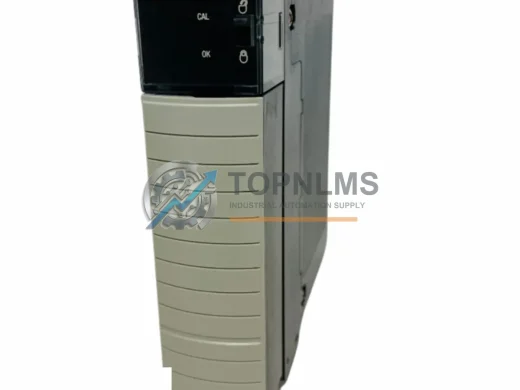
Upgrading or replacing the Allen-Bradley 1734-4IOL IO-Link Master Module in an existing POINT I/O control architecture is one of the most common modernization tasks facing maintenance engineers and system integrators today. Whether your original 1734-4IOL has reached end-of-life, suffered field damage, or your plant is migrating from an older ControlLogix or CompactLogix platform to a newer generation, this replacement module is engineered to deliver a smooth, low-risk transition with minimal disruption to your production line.
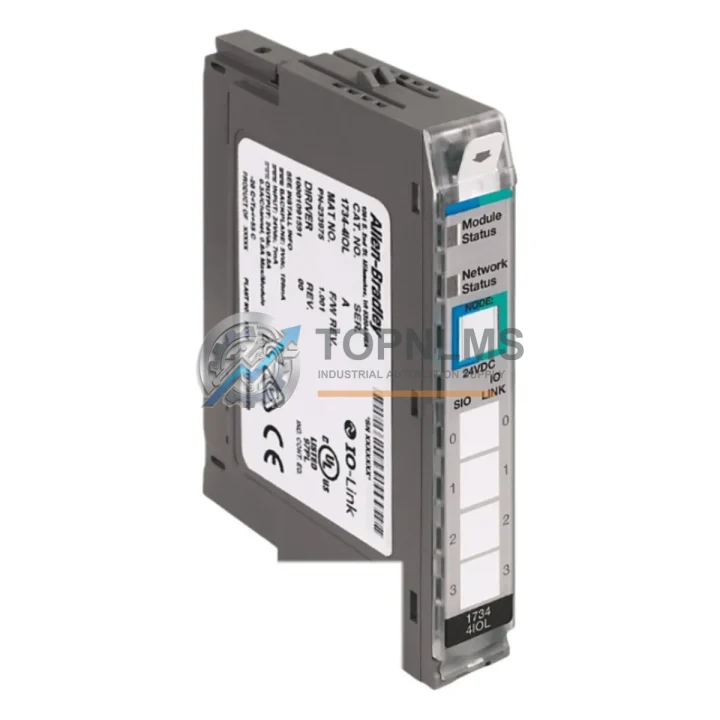
The 1734-4IOL is a 4-port IO-Link master module designed for use within the Allen-Bradley POINT I/O modular I/O system. It mounts directly onto a 1734-TB or 1734-TBS terminal base and communicates upstream via the POINT I/O backplane to an adapter such as the 1734-AENT or 1734-AENTR EtherNet/IP adapter. This architecture means that replacing the 1734-4IOL does not require rewiring the field-side IO-Link device cables — the terminal base remains in place, and the new module simply slides in, preserving all existing sensor and actuator wiring. This is a critical advantage in retrofit scenarios where minimizing downtime is the primary objective.
In practice, many facilities running legacy POINT I/O racks alongside older 1734-IB8 discrete input modules or 1734-OB8 discrete output modules are now standardizing on IO-Link to gain device-level diagnostics and parameterization. The 1734-4IOL serves as the gateway between IO-Link-capable field devices — such as smart sensors, valve terminals, and RFID readers — and the EtherNet/IP network that connects to the Logix controller. When replacing a failed unit, engineers should verify the firmware revision of the replacement module against the existing 1734-AENT adapter firmware to ensure compatibility, as mismatched firmware revisions can cause configuration faults on first power-up.
For sites migrating from an older POINT I/O system that used 1734-ADN DeviceNet adapters, the transition to EtherNet/IP via the 1734-AENTR requires updating the network adapter and reconfiguring the I/O tree in Studio 5000 Logix Designer. The 1734-4IOL module’s Add-On Profile (AOP) must be imported into the project, and each IO-Link port must be configured with the correct device IODD file. This process is straightforward for engineers familiar with the Logix environment, and the module’s configuration is stored in the controller project, making future replacements even faster — the replacement module inherits the configuration automatically upon connection.
Power supply compatibility is another key consideration. The 1734-4IOL draws power from the POINT I/O power bus, and the system’s 1734-EP24DC bus expansion power supply or the main 1734-AENT adapter power input must be verified to supply sufficient current for the additional IO-Link port load. Each IO-Link port can supply up to 200 mA to connected devices, so a 4-port module at full load adds up to 800 mA of field device current demand. In dense racks with multiple 1734-4IOL modules, a 1734-EP24DC power supply injector is typically required to avoid brownout conditions on the I/O bus.
Physical installation is straightforward. The module mounts on a standard 1734-TB or 1734-TBS terminal base on a 35 mm DIN rail. The compact POINT I/O form factor means the 1734-4IOL occupies minimal panel space — an important factor in retrofit projects where the existing control cabinet has limited room. No additional mounting hardware is required beyond the existing terminal base, and the module’s front-panel LED indicators provide immediate visual feedback on port status, IO-Link communication state, and module health.
From a communications protocol perspective, the 1734-4IOL supports IO-Link revision 1.1, which is backward compatible with IO-Link 1.0 devices. This ensures that existing field devices connected to an older IO-Link master can be retained during the upgrade, protecting the investment in smart field instrumentation. Upstream, the module communicates via the POINT I/O backplane to the EtherNet/IP adapter, making it fully compatible with any ControlLogix, CompactLogix, or GuardLogix controller running a current version of Studio 5000.
Compatibility Comparison Table
| Parameter |
Legacy / Outgoing |
1734-4IOL Replacement |
| Module Type |
IO-Link Master (older revision) |
IO-Link Master, Rev 1.1 |
| IO-Link Ports |
4 ports (IO-Link 1.0) |
4 ports (IO-Link 1.1, backward compatible) |
| Terminal Base |
1734-TB / 1734-TBS |
1734-TB / 1734-TBS (same — no rewiring) |
| Network Adapter |
1734-AENT / 1734-AENTR / 1734-ADN |
1734-AENT / 1734-AENTR (EtherNet/IP) |
| Communication Protocol |
DeviceNet or EtherNet/IP |
EtherNet/IP (via POINT I/O backplane) |
| Controller Compatibility |
ControlLogix, CompactLogix |
ControlLogix, CompactLogix, GuardLogix |
| Programming Software |
RSLogix 5000 / Studio 5000 |
Studio 5000 Logix Designer (AOP required) |
| DIN Rail Mounting |
35 mm DIN rail |
35 mm DIN rail (same footprint) |
| Field Device Wiring |
Retained on terminal base |
No rewiring required |
| Warranty |
— |
12-Month Warranty (TOPNLMS) |
Seamless Upgrade Solutions
A complete POINT I/O IO-Link migration typically involves more than just the 1734-4IOL master module. In most retrofit projects, the 1734-AENTR EtherNet/IP adapter is upgraded simultaneously to take advantage of Device Level Ring (DLR) network redundancy, which eliminates single points of failure in the EtherNet/IP network topology. Where the existing rack uses a 1734-ADN DeviceNet adapter, the migration to EtherNet/IP requires replacing the adapter and reconfiguring the network segment entirely.
Power distribution within the rack is managed by the 1734-EP24DC bus expansion power supply, which is commonly added or replaced during a 1734-4IOL upgrade to ensure adequate current capacity for IO-Link field devices. On the field side, IO-Link-capable sensors and actuators — such as smart proximity switches, pressure transmitters, and valve position feedback devices — connect directly to the 1734-4IOL ports via standard 3-wire or 5-wire M12 cables, eliminating the need for separate signal conditioning or 1734-IB8 discrete input modules for those channels.
In mixed-signal racks, the 1734-4IOL coexists with 1734-OB8E electronically fused output modules and 1734-IE4C analog input modules, all sharing the same POINT I/O backplane. The programming cable — typically a 1756-CP3 or USB-to-serial adapter for older controllers — is used during commissioning to connect a laptop running Studio 5000 directly to the ControlLogix chassis for downloading the updated I/O configuration. For remote sites, the 1734-AENTR’s built-in web server provides diagnostic access without requiring a direct programming connection.
Signal isolation requirements between the IO-Link field segment and the control system are typically handled at the IO-Link device level in modern installations, but legacy systems with long cable runs may benefit from adding a DIN-rail-mounted signal isolator between the 1734-4IOL port and the field device to protect against ground loops and transient voltages common in industrial environments.
Retrofit Guidance FAQ
Q: Can I replace the 1734-4IOL without rewiring the field devices?
A: Yes. The field-side IO-Link device cables connect to the 1734-TB or 1734-TBS terminal base, which remains in place. Only the module itself is swapped, so no field wiring changes are required.
Q: Do I need to update my Studio 5000 project after replacing the module?
A: If the replacement module has the same catalog number and firmware revision, the controller will recognize it automatically. If the firmware revision differs, you may need to update the AOP and re-download the project to clear any configuration faults.
Q: Is the 1734-4IOL compatible with IO-Link 1.0 field devices?
A: Yes. The module supports IO-Link revision 1.1, which is fully backward compatible with IO-Link 1.0 devices. Existing field devices do not need to be replaced.
Q: What happens to my IO-Link device parameters during a module swap?
A: IO-Link device parameters are stored in the controller project via the Data Storage function. Upon reconnection, the 1734-4IOL can automatically restore parameters to the field device, minimizing reconfiguration time.
Q: How much physical space does the 1734-4IOL require in the control cabinet?
A: The module uses the standard POINT I/O single-slot footprint on a 35 mm DIN rail. It is a direct physical replacement for the existing module and requires no additional panel space.
Q: Can the 1734-4IOL work with a GuardLogix safety controller?
A: Yes, the 1734-4IOL is compatible with GuardLogix controllers via EtherNet/IP. Note that IO-Link itself is a standard (non-safety) protocol; safety I/O must be handled by dedicated safety modules in the same rack.
Warranty Assurance
Every Allen-Bradley 1734-4IOL IO-Link Master Module supplied by TOPNLMS is covered by a 12-month warranty from the date of shipment. Prior to dispatch, each unit undergoes functional verification testing to confirm module communication, port integrity, and LED indicator operation. In the event of a confirmed defect within the warranty period, TOPNLMS will arrange a replacement unit or full refund — whichever the customer prefers — with priority processing to minimize any impact on production schedules.
Our inventory is maintained in Xiamen, China, with express international shipping available to most destinations within 3–7 business days. All units are shipped in anti-static packaging with individual serial number documentation to support your incoming inspection and asset management processes. For urgent replacement requirements, same-day dispatch is available for in-stock items ordered before 14:00 CST.
Our after-sales team is available to assist with installation questions, firmware compatibility checks, and Studio 5000 configuration guidance throughout the warranty period. We understand that industrial control system downtime is costly, and our procurement support is structured to get your system back online as quickly as possible.