
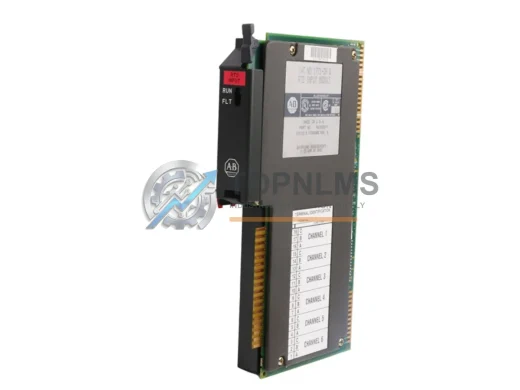
Allen-Bradley
Allen-Bradley 1771-IR Original Industrial Spare PLC-5 Compatible
1771-IRAllen-Bradley 1771-IR 6-Channel RTD Input Module for PLC-5. Original spare, PLC-5 compatible, 12-month warranty. Fast shipping. Industrial replacement.
Request availability, condition, lead time and export shipping details for 1771-IFM.
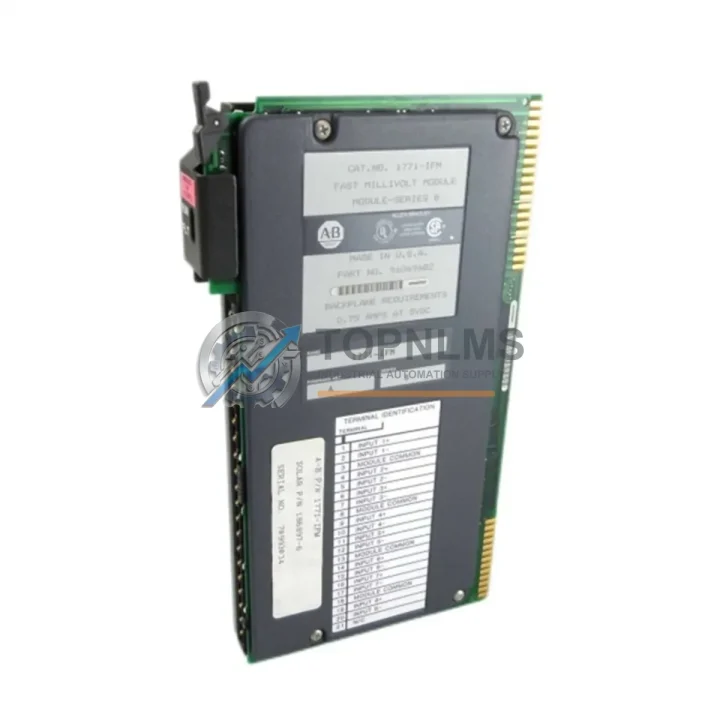
Send this exact part number, quantity and destination country. TOPNLMS will confirm availability, condition and export lead time before quotation.
In industrial automation environments where uptime is measured in revenue and unplanned downtime carries six-figure consequences, the Allen-Bradley 1771-IFM Analog Input Module stands as a critical line of defense. Designed specifically for the Allen-Bradley PLC-5 programmable controller platform, the 1771-IFM delivers eight channels of isolated analog input, enabling precise signal acquisition from field instruments including pressure transmitters, temperature sensors, flow meters, and level transducers. For maintenance engineers managing aging PLC-5 control systems, securing a verified original 1771-IFM spare is not a procurement decision — it is a risk management strategy.
The 1771-IFM occupies a well-established role in process control cabinets across petrochemical, water treatment, food and beverage, and discrete manufacturing facilities. Its channel isolation architecture prevents ground loops and cross-channel interference, a feature that becomes especially critical in electrically noisy industrial environments. When a module fails during production, the consequences extend beyond the module itself: process variables go blind, alarms become unreliable, and operators lose the visibility needed to maintain safe, efficient operations. Having a tested, ready-to-install 1771-IFM on the shelf eliminates the hours — sometimes days — lost to emergency sourcing.
| Parameter | Specification |
|---|---|
| Part Number / SKU | 1771-IFM |
| Brand | Allen-Bradley (Rockwell Automation) |
| Series | PLC-5 I/O Platform |
| Module Type | Analog Input Module |
| Number of Channels | 8 Channels (Isolated) |
| Input Signal Range | 4–20 mA / 0–10 VDC (configurable per channel) |
| Resolution | 12-bit |
| Channel Isolation | Channel-to-channel and channel-to-backplane isolated |
| Compatible Controller | Allen-Bradley PLC-5 Series (1771 I/O chassis) |
| Backplane Compatibility | 1771 I/O Chassis (A, B, C, D, E series) |
| Operating Temperature | 0°C to 60°C (32°F to 140°F) |
| Storage Temperature | -40°C to 85°C |
| Relative Humidity | 5% to 95% non-condensing |
| Power Consumption | Supplied via 1771 backplane |
| Mounting | 1771 I/O chassis slot (single-slot) |
| Certifications | UL Listed, CE Marked |
| Country of Origin | China |
| Condition | Original / Genuine |
| Warranty | 12 Months from date of shipment |
| Maintenance Recommendation | Inspect annually; replace on signal drift or channel failure |
A disciplined preventive maintenance program for PLC-5-based control systems extends well beyond replacing a single module. When scheduling a planned shutdown or responding to an unplanned fault on the 1771-IFM, experienced maintenance teams use the opportunity to audit the entire analog signal chain and adjacent control cabinet components. This approach minimizes repeat callouts and maximizes the value of each maintenance window.
Begin with the 1771-IFM itself: verify channel calibration against known reference signals before removal, and document any channels showing drift beyond ±0.5% of full scale — this data informs whether the fault is module-level or field-instrument-level. While the chassis slot is open, inspect the 1771 I/O chassis backplane for corrosion, bent connector pins, or heat discoloration, as backplane degradation is a common root cause of intermittent module faults that are frequently misdiagnosed as module failures.
Simultaneously, check the 1771-OFE Analog Output Module installed in adjacent slots. Analog output modules in the same chassis share the same environmental stressors as the 1771-IFM, and a failing output module can introduce noise that corrupts input readings. If the control loop includes PID regulation, verify the output module’s calibration alongside the input module replacement.
The 1771-ASB Remote I/O Adapter deserves attention during any PLC-5 maintenance event. As the communication bridge between the PLC-5 processor and remote I/O chassis, a degraded ASB module can cause sporadic I/O faults that mimic module failures. Inspect the Remote I/O cable connections and verify the adapter’s LED status indicators during the maintenance window.
Power quality is a silent contributor to analog module failures. Inspect the 1771-P4S or 1771-P7 Power Supply serving the I/O chassis: measure output voltage under load and check for ripple exceeding specifications. A power supply operating near end-of-life will cause erratic analog readings long before it produces a hard fault. Keeping a spare power supply alongside the 1771-IFM in your critical spares inventory is a low-cost insurance policy against extended downtime.
Field wiring termination is another high-failure-rate area. The 1771-WN Wiring Arm (or equivalent termination assembly) connects field cables to the 1771-IFM. During module replacement, inspect the wiring arm for loose terminals, corroded contacts, and insulation damage. A faulty wiring arm will cause the replacement module to exhibit the same symptoms as the failed unit, leading to unnecessary repeat replacements.
For facilities running 1785-L series PLC-5 processors (such as the 1785-L40B or 1785-L80B), confirm that the processor firmware is compatible with the replacement 1771-IFM revision. Firmware mismatches are rare but can cause configuration errors on first scan after module replacement. Keep a printed copy of the processor’s I/O configuration report in the cabinet documentation folder.
If the PLC-5 system communicates upstream to a SCADA or DCS via 1785-KA5 or 1784-KTX Data Highway Plus communication modules, verify that the communication link remains stable after the I/O replacement. A module swap that inadvertently disrupts the backplane can cause the communication module to drop its connection, triggering false alarms at the supervisory level.
Finally, review the 1771-SDN DeviceNet Scanner Module if present in the chassis. DeviceNet-connected field devices feeding analog signals through gateway modules can mask 1771-IFM faults or be masked by them. A comprehensive fault analysis should include a DeviceNet network health check as part of the analog I/O troubleshooting workflow.
Documenting all findings — module serial numbers, calibration results, wiring arm condition, power supply measurements — in the equipment maintenance log creates a traceable maintenance history that supports future fault diagnosis and justifies capital replacement decisions to plant management.
The Allen-Bradley PLC-5 platform, while no longer in active production, remains deeply embedded in process industries worldwide. Replacing the entire control system is a capital-intensive project requiring engineering redesign, software migration, operator retraining, and extended commissioning periods — often measured in months and millions. For facilities where the PLC-5 system is performing reliably and the process it controls is stable, strategic spare parts management is the most cost-effective path to continued operation.
The 1771-IFM is a prime example of a module where original spare availability directly determines system longevity. Unlike some legacy modules that have been superseded by direct drop-in replacements, the 1771-IFM’s specific combination of channel count, isolation architecture, and backplane interface makes it difficult to substitute without software reconfiguration. Sourcing a genuine original 1771-IFM eliminates the compatibility verification burden and allows maintenance teams to restore production within the same shift the fault occurs.
For facilities managing multiple PLC-5 systems across a plant, a centralized critical spares strategy — maintaining one or two 1771-IFM units per system, stored in ESD-safe packaging in a climate-controlled spares room — reduces the per-incident downtime cost to near zero. The carrying cost of a spare module is a fraction of a single hour of unplanned production downtime in most process industries.
When planning a phased migration from PLC-5 to a modern platform such as the Allen-Bradley ControlLogix or CompactLogix, the 1771-IFM spares inventory supports the legacy system through the transition period, ensuring that a module failure during the migration project does not force an emergency cutover before the new system is fully validated.
All 1771-IFM units supplied by TOPNLMS are tested prior to shipment using functional test procedures that verify all eight analog input channels across the full signal range. Each unit ships with a test report and is covered by a 12-month warranty from the date of shipment, providing procurement teams with the documentation needed for maintenance records and audit compliance.
Q1: What is the expected service life of the 1771-IFM, and when should I plan for replacement?
The 1771-IFM does not have a fixed service life under normal operating conditions, but analog modules in industrial environments typically show performance degradation after 10–15 years due to capacitor aging and contact oxidation. Plan for proactive replacement when channel calibration drift exceeds ±1% of full scale, when any channel produces intermittent faults, or when the module has been in continuous service for more than 10 years in a high-temperature or high-humidity environment. Maintaining at least one spare per system is recommended for facilities where the PLC-5 platform will remain in service for more than 3 years.
Q2: How do I verify compatibility between a replacement 1771-IFM and my existing PLC-5 system?
Compatibility is determined by three factors: chassis type (must be a 1771 I/O chassis), processor series (PLC-5 family, including 1785-L series processors), and RSLogix 5 or 6200 software configuration. The 1771-IFM is compatible across all standard 1771 chassis variants (A through E series). Verify the module revision level against your existing I/O configuration file — in most cases, a higher revision module is backward compatible. If in doubt, contact our technical team with your processor catalog number and we will confirm compatibility before shipment.
Q3: What pre-shipment testing does TOPNLMS perform on the 1771-IFM?
Every 1771-IFM unit undergoes functional testing across all eight analog input channels prior to shipment. Testing verifies signal accuracy across the full 4–20 mA and 0–10 VDC input ranges, channel isolation integrity, and backplane connector condition. A test report is included with each shipment. Units are packed in ESD-safe anti-static bags and shipped in protective foam-lined cartons to prevent transit damage. The 12-month warranty covers manufacturing defects and functional failures under normal operating conditions.
Q4: Can I use the 1771-IFM as a direct replacement for a failed module without reprogramming?
In the majority of cases, yes. The 1771-IFM is a slot-addressed module — the PLC-5 processor reads its configuration from the I/O chassis slot assignment, not from the module itself. Replacing a failed 1771-IFM with an identical catalog number unit in the same chassis slot requires no software changes in most standard configurations. The processor will recognize the replacement module on the next scan cycle. However, if the original module was configured with non-default scaling or filter settings stored in the processor’s I/O configuration, verify those settings in RSLogix 5 before returning the system to automatic operation.
© 2026 TOPNLMS. All rights reserved.
Original Source: https://topnlms.com
Contact: [email protected] | +86 18359293191
Allen-Bradley 1771-IR 6-Channel RTD Input Module for PLC-5. Original spare, PLC-5 compatible, 12-month warranty. Fast shipping. Industrial replacement.
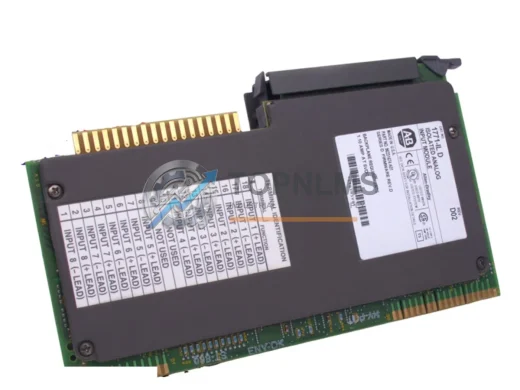
Allen-Bradley 1771-IL 4-ch analog input module for PLC-5. Ruggedized for harsh environments. In stock, tested, 12-month warranty. Ships from TOPNLMS.

Allen-Bradley 1771-IFE/B analog input module replacement for PLC-5 systems. Compatible upgrade, 12-month warranty, fast global shipping from stock.
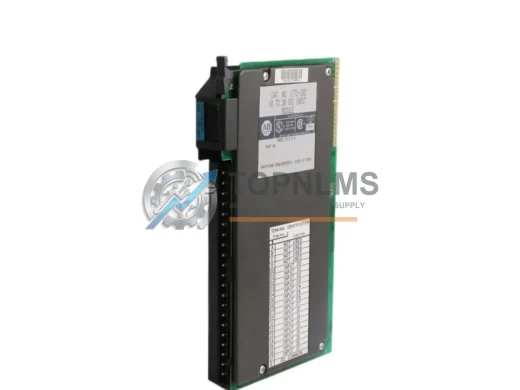
Allen-Bradley 1771-IBD 16-point DC digital input module for PLC-5. Rugged, EMI-resistant, 12-month warranty. In stock — fast global shipping from TOPNLMS.
Click Quote This Model and the Part Number field will auto-fill with 1771-IFM.