Product Overview
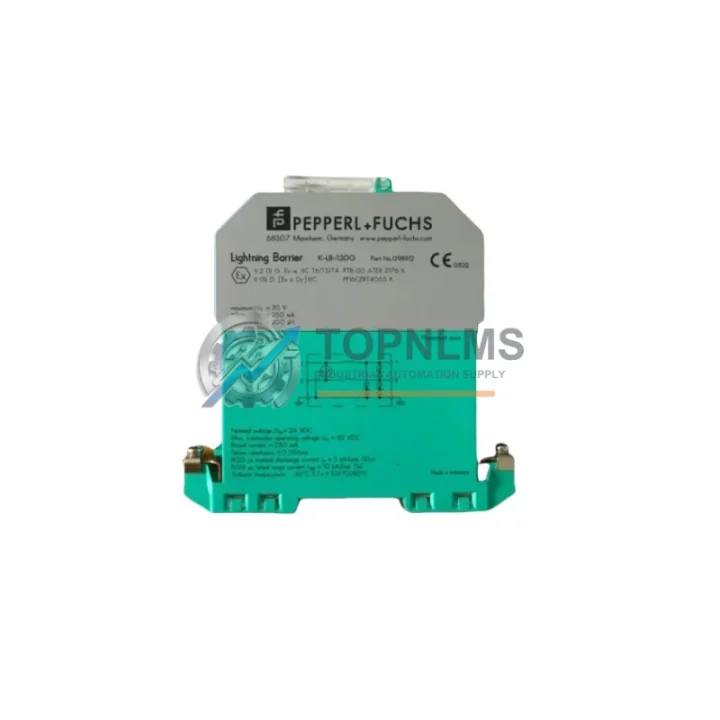
Pepperl+Fuchs K-LB-1.30G Original Spare K-Series Compatible: Surge Protection for Continuous System Stability
In process industries where hazardous area instrumentation is mission-critical, the integrity of every surge protection barrier in the field cabinet directly determines system uptime. The Pepperl+Fuchs K-LB-1.30G is an original K-Series lightning and surge protection barrier engineered to safeguard intrinsically safe field circuits from transient overvoltages caused by lightning strikes, switching surges, and electrostatic discharge events. Maintaining a verified spare of the K-LB-1.30G in your MRO inventory is one of the most cost-effective decisions a maintenance team can make to protect both personnel and instrumentation in Zone 0/1/2 and Division 1/2 classified environments.
The K-LB-1.30G is designed for direct DIN-rail mounting within K-System marshalling cabinets, providing transparent surge suppression without affecting the signal integrity of connected 4–20 mA loops, NAMUR sensors, or discrete field devices. Its compact form factor and plug-in terminal design allow field technicians to execute a hot-swap replacement in minutes, minimising the window of exposure during an unplanned maintenance event.
Critical Technical Specs Table
| Parameter |
Specification |
| Manufacturer |
Pepperl+Fuchs |
| Part Number / SKU |
K-LB-1.30G |
| Series |
K-Series (K-System) |
| Product Type |
Surge Protection Barrier (Lightning Barrier) |
| Protection Standard |
IEC 61643 / EN 61643 compliant surge suppression |
| Rated Voltage |
Up to 30 V DC (signal circuit) |
| Protection Level (Up) |
≤ 30 V (voltage protection level) |
| Nominal Discharge Current (In) |
1 kA (8/20 µs waveform) |
| Maximum Discharge Current (Imax) |
2.5 kA (8/20 µs waveform) |
| Signal Type Compatibility |
4–20 mA analog, NAMUR, discrete binary signals |
| Mounting |
DIN rail (35 mm), plug-in terminal blocks |
| Housing / Enclosure |
Compact K-System module housing |
| Operating Temperature |
-20 °C to +60 °C |
| Storage Temperature |
-40 °C to +85 °C |
| Degree of Protection |
IP20 (installed in control cabinet) |
| Country of Origin |
Germany |
| Hazardous Area Classification |
Zone 0, 1, 2 / Division 1, 2 (when used with certified IS barriers) |
| Compatibility |
Pepperl+Fuchs K-System marshalling cabinets and K-Series module racks |
| Warranty |
12 Months — All units tested prior to dispatch |
Preventive Maintenance Strategy
Surge protection barriers are among the most overlooked components in a preventive maintenance programme, yet a failed or degraded K-LB-1.30G can expose an entire field loop — and the IS barrier or isolator behind it — to damaging transients. During scheduled cabinet inspections, maintenance engineers should treat the K-LB-1.30G as part of a broader surge and signal integrity audit.
Begin by verifying the condition of the K-LB-1.30G alongside the associated Pepperl+Fuchs K-System IS barriers (such as the K-HI-1 or K-DO-1 series) that protect the same field loop. A surge event that has triggered the barrier’s suppression elements may have also stressed the downstream isolator, making it prudent to inspect both simultaneously. Check the barrier’s status indicator (where fitted) and measure loop resistance to confirm the signal path remains unimpeded.
In the same cabinet inspection cycle, review the K-System power supply module (e.g., K-PS series) that feeds the marshalling rack. Surge events that reach the barrier often originate from the field cable entry, but power rail transients can propagate in the opposite direction; a healthy, correctly rated power supply is the first line of defence. Inspect the DIN rail terminal blocks and cable shield grounding clamps at the cabinet entry gland plate — loose or corroded shield terminations are a primary cause of recurring surge damage.
For facilities running Pepperl+Fuchs K-System signal conditioners and isolators (K-FA, K-FB, or K-FC series), it is good practice to cross-check the isolation resistance of field cables during the same maintenance window. A degraded cable insulation will allow surge energy to bypass the barrier’s protection path. Similarly, inspect K-System relay output modules (K-DO series) in the same cabinet, as inductive load switching on relay outputs can generate internal transients that stress adjacent surge protection components.
Where the K-LB-1.30G protects a loop feeding a HART-capable transmitter or a Pepperl+Fuchs WirelessHART adapter, confirm that the HART communication signal is still passing cleanly after any surge event — some suppression components can introduce impedance that attenuates the HART signal at higher frequencies. Finally, ensure that the cabinet earthing busbar and all PE connections on the K-System rack are torqued to specification; a high-impedance earth connection renders surge protection ineffective regardless of the barrier’s rated discharge capacity.
Stocking a minimum of two K-LB-1.30G units per marshalling cabinet as on-site spares is a widely adopted best practice in petrochemical, pharmaceutical, and power generation facilities. The low unit cost relative to the downtime risk of an unprotected field loop makes this one of the highest-return inventory decisions available to a maintenance planner.
Strategic Replacement Solutions
The K-LB-1.30G has been a long-standing component in Pepperl+Fuchs K-System installations dating back to the early 2000s. Many plants operating legacy DCS or safety instrumented systems (SIS) built around K-System marshalling still rely on this exact part number, and direct replacement with an original K-LB-1.30G is the lowest-risk path to restoring protection without any re-engineering of the field loop or cabinet wiring.
Unlike generic third-party surge suppressors, the K-LB-1.30G is dimensioned to fit the K-System DIN rail footprint and uses the same plug-in terminal interface as all other K-Series modules. This means a trained technician can remove the degraded unit and install the replacement in under five minutes without disturbing adjacent wiring — a critical advantage when the plant is operating and cabinet access time is limited.
For sites that are migrating from older K-System configurations to newer Pepperl+Fuchs F-System or LB/FB remote I/O architectures, the K-LB-1.30G can continue to serve as the surge protection layer at the marshalling cabinet while the upstream IS barriers or isolators are upgraded incrementally. This phased approach preserves capital expenditure budgets while maintaining full hazardous area compliance throughout the transition.
Each K-LB-1.30G supplied by TOPNLMS is sourced from authorised distribution channels, individually inspected, and function-tested before dispatch. Units are shipped with original manufacturer packaging and documentation. A 12-month warranty covers all supplied units against manufacturing defects and functional failure under normal operating conditions.
Support FAQ
Q1: How do I verify that my K-LB-1.30G has been triggered or degraded by a surge event?
A: Visual inspection of the status indicator (if fitted) is the first step. Follow up with a loop resistance measurement — a significant increase in resistance compared to the baseline value recorded during commissioning indicates that the suppression elements may have been partially consumed. If in doubt, replace the unit; the cost of a spare K-LB-1.30G is negligible compared to the cost of a field transmitter damaged by an unprotected transient.
Q2: Is the K-LB-1.30G compatible with all K-System marshalling racks?
A: Yes. The K-LB-1.30G uses the standard K-System DIN rail footprint and plug-in terminal interface, making it compatible with all generations of Pepperl+Fuchs K-System marshalling racks and cabinets. No adapter or modification is required.
Q3: How many units should I stock as on-site spares?
A: Industry best practice for hazardous area instrumentation cabinets is a minimum of two units per cabinet, or 10% of the total installed quantity (whichever is greater). Given the low unit cost and the critical protection function, many facilities maintain a higher buffer, particularly in coastal or high-lightning-incidence locations.
Q4: What testing is performed before dispatch, and what does the 12-month warranty cover?
A: Every K-LB-1.30G unit is visually inspected and electrically tested for continuity and correct suppression element integrity before shipment. The 12-month warranty covers manufacturing defects and functional failure under normal operating conditions. It does not cover damage resulting from installation errors, operation outside rated parameters, or physical damage in transit (transit damage claims must be raised within 48 hours of receipt).