Product Overview
Allen-Bradley 1786-TPS Ruggedized ControlNet T-Tap for Harsh Environments
The Allen-Bradley 1786-TPS is a ControlNet coaxial straight T-tap connector engineered for continuous, reliable operation in the most demanding industrial environments. As a core physical-layer component of Rockwell Automation’s 1786 ControlNet series, the 1786-TPS provides a robust, low-loss signal junction point that maintains network integrity even under conditions of extreme temperature fluctuation, persistent mechanical vibration, airborne particulate contamination, and elevated electromagnetic interference (EMI). Whether deployed on a high-speed automotive assembly line, inside a petrochemical processing unit, or across a distributed power generation facility, this connector delivers the deterministic, high-speed communication that mission-critical control architectures demand.
ControlNet is a producer-consumer network protocol widely used in safety-critical and time-sensitive automation systems. The 1786-TPS straight T-tap allows field engineers to branch a ControlNet trunk cable to a node device — such as a ControlLogix or CompactLogix PLC chassis, a remote I/O adapter, or a variable frequency drive — without interrupting the main trunk. Its coaxial design preserves signal impedance matching across the network segment, preventing reflections that could degrade communication quality or trigger nuisance faults in connected controllers. In environments where unplanned downtime carries significant financial or safety consequences, the mechanical and electrical integrity of every network junction point is non-negotiable.
In heavy industrial settings — including mining operations, steel mills, cement plants, and offshore platforms — network connectors are routinely exposed to shock loads, continuous vibration from rotating machinery, corrosive atmospheres, and wide ambient temperature swings. The 1786-TPS is designed to withstand these conditions, maintaining a secure, gas-tight coaxial connection that resists oxidation and contact degradation over extended service intervals. When paired with Allen-Bradley 1786-RG6 ControlNet coaxial trunk cable and 1786-TPYR right-angle T-tap variants, the 1786-TPS forms part of a complete, field-proven physical-layer infrastructure that supports the full 1786 ControlNet topology.
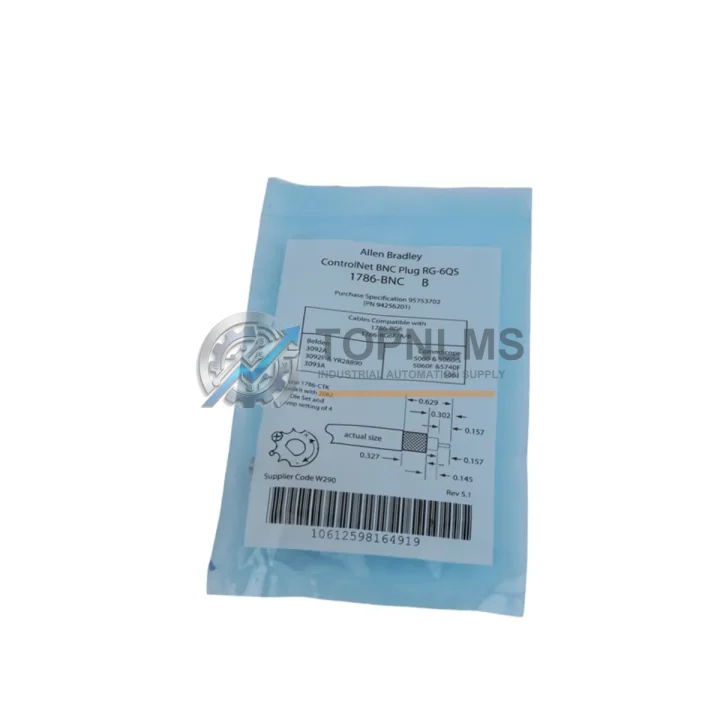
System integrators building or expanding ControlNet segments frequently specify the 1786-TPS alongside the 1786-BNC BNC terminator, which is required at each end of a ControlNet trunk to properly terminate the 75-ohm coaxial cable and prevent signal reflections. The 1786-RPCD ControlNet repeater is another common companion component, used to extend network segments beyond the standard distance limits or to bridge between redundant media paths in high-availability architectures. For installations requiring network media redundancy, the 1786-RPFRL fiber-optic repeater module can be integrated to provide an alternative signal path immune to EMI — a critical consideration in environments with large motor drives, welding equipment, or high-voltage switchgear in close proximity.
At the controller level, the 1786-TPS supports connectivity to Allen-Bradley ControlLogix 1756-CNB and 1756-CNBR ControlNet bridge modules, which serve as the network interface between the ControlLogix backplane and the ControlNet segment. These bridge modules, housed in 1756 series chassis alongside processor modules such as the 1756-L71 or 1756-L83E, rely on the physical integrity of every T-tap and trunk cable segment to maintain the scheduled and unscheduled communication that drives coordinated motion, process control, and safety interlock functions. A compromised T-tap connection can introduce latency or packet loss that propagates as controller faults, making the quality and reliability of the 1786-TPS a direct factor in overall system uptime.
For distributed I/O applications, the 1786-TPS enables connection of 1794 FLEX I/O adapters and 1734 POINT I/O communication modules to the ControlNet trunk, extending digital and analog I/O capabilities to remote field panels and junction boxes without requiring additional controller hardware. In process industries such as water treatment, oil and gas, and chemical manufacturing, this distributed architecture allows a single ControlNet segment to span large physical distances while maintaining the real-time data exchange required for regulatory compliance and process safety management.
Procurement teams sourcing spare parts for existing ControlNet installations will find the 1786-TPS an essential stocking item. As ControlNet infrastructure ages, T-tap connectors are among the first components to show wear from repeated cable insertions, thermal cycling, and mechanical stress. Maintaining an adequate inventory of 1786-TPS connectors ensures that maintenance teams can execute rapid connector replacements during scheduled shutdowns or emergency repairs, minimizing mean time to repair (MTTR) and protecting production continuity. TOPNLMS stocks the 1786-TPS as a genuine Allen-Bradley component, with each unit subject to pre-shipment functional inspection to verify connector integrity and dimensional conformance.
Rugged Specifications Table
| Attribute |
Detail |
| Part Number / SKU |
1786-TPS |
| Brand |
Allen-Bradley (Rockwell Automation) |
| Series |
1786 ControlNet |
| Product Type |
ControlNet Coaxial Straight T-Tap Connector |
| Network Protocol |
ControlNet (IEC 61158) |
| Cable Compatibility |
RG-6 Coaxial Trunk Cable (75 Ω) |
| Connector Style |
Straight (inline trunk tap) |
| Operating Temperature |
0 °C to +60 °C (32 °F to 140 °F) |
| Storage Temperature |
-40 °C to +85 °C |
| Ingress Protection |
Suitable for use in standard industrial enclosures; pair with IP65/IP67 enclosures for harsh environments |
| EMI Resistance |
Coaxial shielded design; inherent EMI rejection via 75 Ω impedance-matched coaxial architecture |
| Vibration Resistance |
Designed to IEC 60068-2-6 industrial vibration standards |
| Compatible Controllers |
ControlLogix (1756), CompactLogix (1769), PLC-5 with ControlNet interface |
| Compatible Network Modules |
1756-CNB, 1756-CNBR, 1784-PCIC, 1786-RPCD |
| Country of Origin |
United States |
| Weight |
80 g |
| Warranty |
12 Months — covers manufacturing defects and functional failure under normal operating conditions |
| Condition |
Genuine Allen-Bradley; pre-shipment inspected |
Comprehensive Protection Solutions
A reliable ControlNet segment is only as strong as its weakest physical-layer component. When deploying or maintaining a ControlNet network, the 1786-TPS straight T-tap is typically used in conjunction with a carefully selected set of complementary components. The 1786-BNC terminator is installed at both ends of every trunk segment to absorb signal energy and prevent reflections that would otherwise corrupt data frames. Where trunk segments must be extended or isolated, the 1786-RPCD coaxial repeater regenerates the ControlNet signal, allowing longer cable runs and improved noise immunity in electrically noisy environments such as motor control centers or arc furnace facilities.
For installations requiring media redundancy — a common requirement in continuous process industries and safety-instrumented systems — the 1786-RPFRL fiber-optic repeater provides a galvanically isolated, EMI-immune signal path that can operate in parallel with the coaxial trunk. At the controller level, the 1756-CNB ControlNet bridge module connects the ControlLogix backplane to the ControlNet segment, while the 1756-CNBR redundant bridge module supports dual-media configurations for high-availability control systems. Remote I/O nodes connected via the 1786-TPS may include 1794-ACN15 FLEX I/O ControlNet adapters, which interface analog and digital I/O modules to the network, and 1734-ACNR POINT I/O ControlNet adapters for compact, DIN-rail-mounted distributed I/O in field panels.
Power supply reliability is equally critical in these architectures. Allen-Bradley 1606-XLP series industrial power supplies are commonly specified to power ControlNet network equipment and I/O racks, providing regulated 24 VDC output with wide input voltage range and high immunity to input transients. Safety relay modules such as the 440R Guardmaster series are often integrated into the same control cabinet, providing hardwired safety interlock functions that complement the ControlNet-based control logic. Together, these components — connected through the physical infrastructure anchored by the 1786-TPS — form a layered, defense-in-depth control architecture capable of sustaining safe, continuous operation in the harshest industrial environments.
Application in Critical Infrastructure
The Allen-Bradley 1786-TPS is deployed across a broad spectrum of critical infrastructure sectors where network reliability directly impacts operational safety and regulatory compliance. In oil and gas upstream and midstream facilities, ControlNet segments built around the 1786-TPS connect wellhead controllers, compressor station PLCs, and emergency shutdown (ESD) systems, where deterministic communication timing is essential for coordinated safety responses. Offshore platform installations present particular challenges — salt-laden air, constant vibration from wave action and rotating machinery, and wide temperature swings demand connectors that maintain gas-tight, corrosion-resistant connections over multi-year service intervals without maintenance access.
In mining operations — including underground coal mines, open-pit copper and iron ore facilities, and mineral processing plants — the 1786-TPS supports ControlNet segments that link conveyor drive controllers, crusher automation systems, and ventilation control PLCs. The coaxial cable infrastructure provides inherent immunity to the high levels of EMI generated by large variable frequency drives and DC motor drives common in these environments. Water and wastewater treatment facilities rely on ControlNet-connected I/O systems for continuous monitoring and control of pumping stations, chemical dosing systems, and filtration processes, where uninterrupted network communication is required to maintain effluent quality standards and regulatory permit compliance.
Power generation and transmission facilities — including thermal power plants, hydroelectric stations, and grid substations — use ControlNet infrastructure to integrate turbine control systems, generator protection relays, and balance-of-plant automation. The 1786-TPS enables the physical network connections that support real-time data exchange between distributed control nodes, ensuring that operators maintain full situational awareness and control authority across the facility. In metallurgical plants and steel mills, where ambient temperatures near furnaces can exceed 50 °C and airborne metallic particulate is a constant concern, the robust coaxial connector design of the 1786-TPS provides the connection reliability that keeps production lines running at rated capacity.
Security & Quality FAQ
Q1: What does the 12-month warranty cover for the 1786-TPS?
The 12-month warranty covers manufacturing defects, connector dimensional non-conformance, and functional failure under normal operating conditions from the date of shipment. If a unit fails within the warranty period due to a covered defect, TOPNLMS will provide a replacement unit at no additional cost. The warranty does not cover damage resulting from improper installation, cable over-insertion, or exposure to conditions outside the published operating specifications.
Q2: How is each 1786-TPS unit tested before shipment?
Every 1786-TPS unit in TOPNLMS inventory undergoes a pre-shipment inspection that includes visual examination for connector body integrity, center conductor condition, and outer shield continuity. Units are verified as genuine Allen-Bradley components through part marking and dimensional inspection. Stock is stored in ESD-safe, climate-controlled conditions to prevent connector oxidation or mechanical damage prior to dispatch.
Q3: Is the 1786-TPS compatible with all ControlNet trunk cable types and node devices?
The 1786-TPS is designed for use with Allen-Bradley 1786-RG6 RG-6 coaxial trunk cable and is compatible with all standard ControlNet node devices that use the BNC tap interface, including ControlLogix 1756-CNB bridge modules, CompactLogix ControlNet interfaces, PLC-5 ControlNet processors, and third-party ControlNet devices conforming to the ControlNet International specification. It is not interchangeable with DeviceNet or EtherNet/IP physical-layer components.
Q4: Can TOPNLMS support long-term or repeat procurement of the 1786-TPS for ongoing maintenance programs?
Yes. TOPNLMS maintains standing inventory of the 1786-TPS and related 1786 series ControlNet components to support planned maintenance programs, capital spares strategies, and emergency replacement requirements. Customers with recurring procurement needs are encouraged to contact our sales team to discuss volume pricing, reserved stock arrangements, and lead-time commitments that align with their maintenance schedules and shutdown planning cycles.