
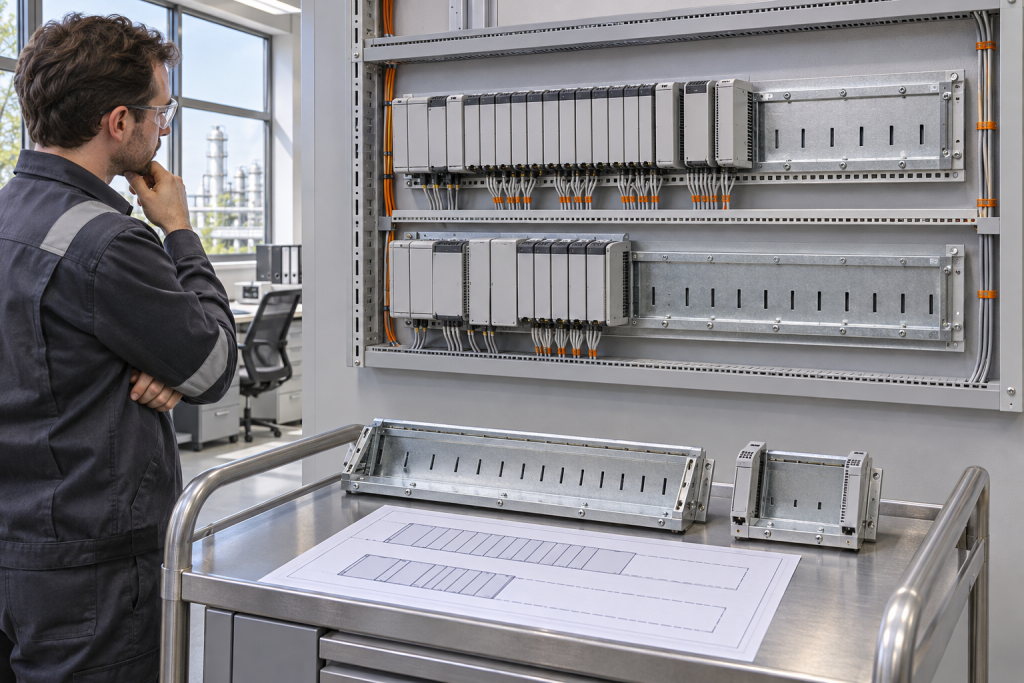
A smaller carrier seems like an easy way to recover cabinet space during a DeltaV renewal. The modules fit the proposed drawing, the enclosure gains room and the purchase list becomes shorter. But physical space is not the only resource being rearranged. The controller’s interpretation of the I/O layout must remain consistent with the application’s references.
This is why a carrier should not be treated as an anonymous mounting accessory. Its place in the architecture affects what can be retained, what must be checked and how much of the original arrangement remains valid after a change. The question for an aging installation is not only whether a carrier is available; it is whether the renewal preserves the intended system map.
The manufacturer identifies a specific numbering trap
The January 2024 Emerson M-series horizontal-carrier data sheet states that M-series controllers do not distinguish a four-wide carrier from an eight-wide carrier in the same way a PK controller does. Its example places a four-wide carrier’s slots at 1-4 and a following eight-wide carrier’s slots at 9-16. It also identifies a physical compatibility boundary between M-series I/O carriers and S-series controller carriers, with a specified SIS-adapter exception. These are architecture conditions, not a universal migration recipe.
The maintenance implication is straightforward: do not approve a space-saving carrier change using only a mechanical layout. The controller family, software configuration and expected slot references need a coordinated review. A drawing that looks neat can still describe the wrong logical arrangement for the installed system.
Keep the installed map as the baseline
Before discussing a replacement, capture the actual carrier sequence, controller identity, module positions and terminal-block references. Compare this record with the engineering configuration. Photographs help establish the physical order, but they cannot replace the application’s logical references. Both views are needed to describe what the plant intends to preserve.
A sourcing inquiry for the KJ4001X1-BA3 carrier reference should identify its installed role and complete assembly markings. Do not use the term DeltaV compatible as a blanket statement that the item belongs anywhere in the system. Confirm the role, revision and applicable documentation with the responsible engineer.
For an I/O-carrier requirement, the KJ4001X1-BE1 I/O carrier listing provides another specific inquiry reference. Verify the complete unit identity and required field-power arrangement. Descriptive catalog adjectives do not establish a special environmental approval or permission to change the installed architecture.
Compare the renewal choices by what they preserve
| Proposed work | Question to resolve before purchase |
|---|---|
| Like-for-like carrier replacement | Does the complete identity and approved arrangement match the installed baseline? |
| Different carrier width or sequence | How will the controller interpret the revised positions and references? |
| Controller-family migration | Which existing carrier, I/O and configuration assumptions remain valid? |
| Cabinet consolidation | Which electrical, mechanical and documentation boundaries also change? |
These are different engineering packages, even if they share some purchased parts. Calling all four a spare replacement hides the review effort. A useful quotation clearly identifies whether the supplier is providing exact hardware, a proposed alternative or a separately defined engineered solution.
For a plant approaching an eventual modernization, a like-for-like carrier spare may preserve a known arrangement while the larger project is developed. That is a bridge strategy, not an argument against upgrading. The value comes from retaining a documented recovery route without pretending that a small hardware purchase completes the migration.
Use a change ledger instead of relying on memory
For each affected position, record the installed state, proposed state, reason for change and evidence required for approval. Include any dependent drawings, module references and application records. An unresolved item should have a named owner. Without that ownership, small inconsistencies can travel from the design review into the purchasing list and then into the outage work pack.
Consider an illustrative renewal where a new layout saves enclosure space but shifts the relationship between physical positions and software references. The correct response is not to assume that an operator display will reveal every mismatch. Review the mapping systematically in an approved test environment and compare the expected process associations before release.
The test scope should be derived from the actual change. A retained architecture and a changed controller family do not necessarily need the same evidence. Document what has been checked, what remains unchanged and what is outside the test boundary. Do not use the result of a single powered module as proof that the whole I/O arrangement is correct.
Protect the outage and the investigation
Carrier work can affect more than the module that first attracted attention. The responsible team should define isolation, affected equipment and permitted work steps from the exact manufacturer instructions and the site’s operating procedures. This article does not authorize live removal, online rearrangement or a shortcut around a controlled shutdown.
Keep removed hardware identified until the investigation is closed. Physical damage, contamination or an unreliable connection can explain an event that a later functional test does not reproduce. Record why the part was removed and avoid returning it before the engineer has decided which evidence is needed.
After acceptance, reconcile the spare register with the final installed arrangement. A spare left over from the previous layout should not remain marked as universally usable. It may still be valuable for another approved installation, but that allocation needs to be explicit. Good lifecycle planning includes withdrawing obsolete assumptions from the stock system.
Frequently asked questions
Can a smaller carrier be selected purely to save space?
No. Review the controller’s interpretation of the arrangement and the application references as well as the physical fit. A mechanical improvement can create an unreviewed logical change.
Does the same DeltaV brand imply cross-series carrier compatibility?
No. The manufacturer documents specific architecture boundaries and exceptions. Apply the exact product documentation rather than inferring compatibility from a shared system name.
Is a like-for-like carrier spare a reasonable bridge to modernization?
It can be, when it supports a documented installed arrangement and a defined remaining service period. Keep that bridge decision separate from the scope and approval of the future migration.
What should be sent for a carrier quotation?
Provide full assembly markings, controller family, carrier sequence, required condition, delivery destination and whether the work is an exact replacement or a proposed change. Include photographs without exposing unnecessary plant information.
Contact TOPNLMS with the exact carrier identities and the arrangement you need to retain. A scoped hardware inquiry can support the renewal plan while system mapping, compatibility and commissioning remain under your engineering authority.
Image: AI-generated editorial illustration, not an exact product photograph or installation reference.
© 2026 TOPNLMS. All rights reserved. Official Website: https://topnlms.com Inquiry: [email protected] | WhatsApp/Tel: +86 18359293191