
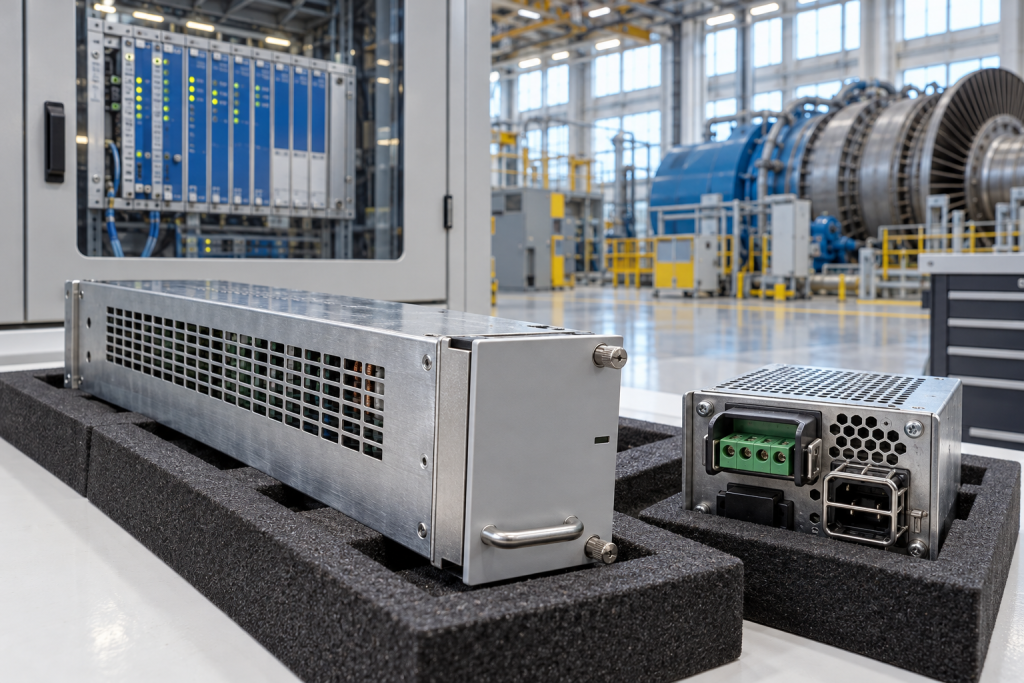
A quotation for a 3500/15 power supply can look complete while omitting the item that determines whether the repair is usable: the associated rear power input module, or PIM. Buying the front module by family name alone risks confusing a like-for-like repair with a change of power-supply generation.
For machinery protection equipment, that distinction belongs in the purchase scope before delivery. It should not be discovered beside a running turbine when the replacement is unpacked. The objective is a documented, compatible repair arrangement, not simply a box marked “3500 power supply.”
Read the front and rear as a pair
Bently Nevada’s 3500/15 datasheet 141530, revision P distinguishes power supplies from their associated PIMs. Its spare-parts table identifies 114M5330-01 as a low-voltage DC power supply and 114M5335-01 as the corresponding low-voltage DC PIM. The document also warns against mixing the described newer power-supply/PIM arrangements with the legacy arrangements.
A 114M5330-01 low-voltage DC power supply is therefore an exact-reference starting point for an inquiry. It is not evidence that the rear module is included, nor proof that the installed PIM belongs to the compatible generation. Ask for the package contents explicitly and verify the installed rear reference through approved access procedures.
Keep three descriptions separate: the complete system configuration, the front spare module and the rear input module. Different documents may refer to different levels of that assembly. An ambiguous purchasing line can cause a supplier and a plant engineer to agree on a family name while expecting different physical contents.
Do not confuse a repair with a conversion
A like-for-like repair aims to restore an approved arrangement. A conversion changes that arrangement and may require more parts, documentation and engineering review. If the proposed supply generation differs from the installed one, stop calling the job a simple swap until the manufacturer compatibility requirements and the full scope have been resolved.
The same caution applies to changes in source type. An AC supply and a DC supply may both serve the same monitoring family, but they do not become interchangeable purchase items. The source, input module, approvals and installed configuration need to be considered together. A visual match at the front of the rack is not enough.
Do not infer compatibility from voltage alone. A shared voltage description leaves the mechanical arrangement, generation and approved application unresolved. Use the applicable OEM documents and, where needed, written manufacturer clarification. A supplier’s broad “replacement solution” heading should lead to that review, not replace it.
Define the repair package in plain language
The purchase request should state whether it covers only the front supply or a reviewed front-and-rear package. List each required reference separately, including the PIM if it is in scope. Ask the supplier to confirm which items are physically included rather than relying on a photograph containing several components.
Also identify the condition of the offered unit, traceability evidence and the limits of any test report. A power-on observation is not equivalent to demonstrating the complete rack in the plant’s operating configuration. If a test report covers only one module, its scope should remain attached to that module rather than being expanded into a claim about the entire protection system.
Use receiving inspection to reconcile the quote, packing list and actual identifiers before the equipment is released to maintenance. An early mismatch is a procurement problem that can be resolved calmly. The same mismatch during an outage becomes an operational problem with much less room for investigation.
Redundancy is not a shortcut around the work plan
The OEM datasheet describes arrangements with one or two supplies. Whether a particular maintenance action is permitted depends on the actual installation, healthy remaining equipment and the approved procedure. The existence of a second front panel is not sufficient evidence that the remaining path can safely support the intended work.
Before a planned repair, the responsible team should establish the current system condition and the boundaries of the task. This article is not a live replacement procedure. Do not remove a supply or input module to discover its identity while the protection system is relied upon unless the authorized procedure explicitly permits that action.
Power restoration also does not prove the entire machinery protection function. After the repair, the relevant system checks must address the approved scope. The related 3500 probe-to-trip recovery discussion explains why a functioning rack and a verified protection path are different questions. Use that broader view without unnecessarily expanding a narrowly defined maintenance job.
A useful acceptance record has a before and an after
The before record identifies the installed front and rear references, the reported symptom and the approved repair decision. The after record identifies what was actually installed and the evidence used to release the system. If the job changed from repair to conversion, that change must be visible rather than hidden inside the technician’s notes.
Retain the removed components with a clear status until the fault investigation is complete. A failed or uncertain PIM should not return to available stock just because a front supply was replaced at the same time. Equally, do not label both items defective without evidence. Accurate disposition helps the next buyer distinguish a proven spare shortage from a stock-record error.
For long-term support, keep the pairing information in the spare record. Future purchasing staff may not have access to the engineer who completed today’s review. A record that names both parts and cites the applicable OEM revision is much more durable than a note saying “same as last order.”
Questions about 3500/15 purchasing
Does a front power supply quotation normally include the PIM?
Do not assume it does. Require a written package list with separate identifiers. A product family photograph or a general replacement description does not establish the delivered contents.
Can the old rear module stay when the front generation changes?
Only if the manufacturer documentation explicitly supports the proposed arrangement. The cited datasheet contains generation-compatibility warnings, so matching by appearance or voltage is not a sufficient basis.
Should we buy an extra PIM for every supply?
Not automatically. Base the reserve on the installed arrangements, failure evidence and recovery requirement. The important first step is knowing which pairing is required and which component the existing stock actually covers.
What information is needed for an accurate quotation?
Provide readable front and rear references, the source type, quantity, condition requirement and destination. State whether the request is like-for-like recovery or a proposed conversion, and identify any unresolved compatibility question.
Contact TOPNLMS for a reference-specific 3500/15 quotation with explicit package contents. Resolve the front-module and PIM relationship before releasing the order, then keep installation and protection-system acceptance under the plant’s authorized procedures.
Image: AI-generated editorial illustration, not an exact product photograph or installation reference.
© 2026 TOPNLMS. All rights reserved. Official Website: https://topnlms.com Inquiry: [email protected] | WhatsApp/Tel: +86 18359293191