

Woodward
WOODWARD APP-PS7-PCI Original Industrial Spare PS7 Compatible
APP-PS7-PCIWOODWARD APP-PS7-PCI original PS7 series governor PC board. Direct industrial replacement, 12-month warranty, tested before shipment. Fast worldwide delivery.
Request availability, condition, lead time and export shipping details for SST-DN3-PCI-2.
Send this exact part number, quantity and destination country. TOPNLMS will confirm availability, condition and export lead time before quotation.
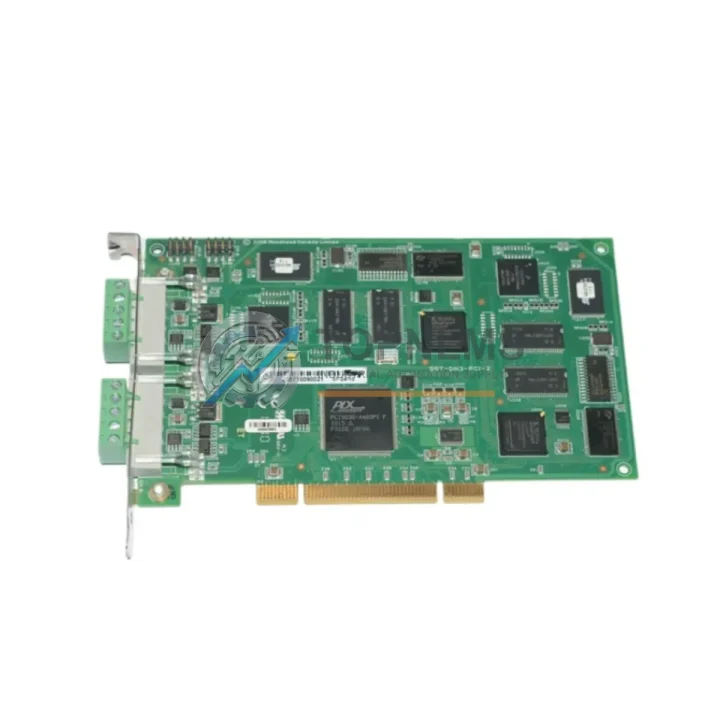
The WOODWARD SST-DN3-PCI-2 is a genuine DeviceNet PCI Interface Card from the SST series, engineered for reliable fieldbus communication in demanding industrial automation environments. For maintenance engineers and procurement teams managing aging control systems, securing an original spare of this card is a critical step in protecting system uptime, reducing unplanned downtime risk, and extending the operational life of existing PLC and DCS architectures.
DeviceNet networks remain deeply embedded in manufacturing, automotive assembly, food processing, and process control facilities worldwide. When a communication interface card fails, the entire fieldbus segment — and potentially the production line — can halt. Having a verified, tested replacement unit of the SST-DN3-PCI-2 on the shelf is not a luxury; it is a fundamental element of any responsible spare parts strategy for facilities running DeviceNet-based control systems.
This card interfaces directly with the host PC or industrial workstation via a standard PCI slot, enabling real-time DeviceNet master or slave communication. Its compatibility with the SST series driver stack and widely adopted DeviceNet configuration tools makes it a drop-in replacement for failed or degraded units without requiring software reconfiguration or system re-engineering — a decisive advantage during emergency maintenance windows.
| Parameter | Specification |
|---|---|
| Part Number / SKU | SST-DN3-PCI-2 |
| Brand | WOODWARD (SST Series) |
| Product Type | DeviceNet PCI Interface Card |
| Bus Interface | PCI (32-bit, 5V/3.3V universal) |
| Fieldbus Protocol | DeviceNet (CAN-based, ISO 11898) |
| Node Support | Up to 64 nodes per network |
| Operating Mode | Master / Slave (configurable) |
| Data Rate | 125 kbps / 250 kbps / 500 kbps |
| Operating Temperature | 0°C to +60°C |
| Storage Temperature | -40°C to +85°C |
| Power Consumption | Supplied via PCI bus |
| Weight | 1150 g (packaged) |
| Country of Origin | United States |
| Compatibility | SST-DN3-PCI series; compatible with RSNetWorx for DeviceNet, SST Configuration Utility |
| Application Environment | Industrial PC, SCADA workstation, PLC gateway host |
| Maintenance Note | Inspect PCI slot contacts and DeviceNet trunk cable termination resistors during replacement |
| Warranty | 12 Months — tested and verified before shipment |
A DeviceNet communication failure rarely occurs in isolation. When scheduling maintenance or responding to a fieldbus fault, experienced engineers know that the SST-DN3-PCI-2 sits at the center of a broader communication ecosystem — and a thorough inspection of surrounding components is essential to prevent repeat failures and ensure long-term system stability.
Begin with the DeviceNet trunk cable and drop cables: inspect for insulation damage, loose termination resistors (120Ω at each end of the trunk), and corroded connectors. A degraded cable plant is the most common root cause of intermittent DeviceNet communication errors that eventually stress and damage the interface card itself.
Next, verify the DeviceNet power supply module — typically a dedicated 24VDC network power supply feeding the DeviceNet bus. Voltage sag or ripple on the network power rail can cause node dropouts and corrupt the card’s communication buffers. If the power supply is original equipment from the initial system commissioning, it should be evaluated for replacement as part of the same maintenance cycle.
Inspect all DeviceNet I/O adapter modules connected to the network. Slave devices such as distributed I/O blocks, valve manifold controllers, and motor drive adapters accumulate wear and may exhibit intermittent faults that are misdiagnosed as host card failures. Confirming the health of each node before and after replacing the SST-DN3-PCI-2 prevents unnecessary repeat work orders.
The industrial PC or workstation chassis hosting the PCI card deserves attention as well. Check the PCI slot for oxidation, verify that the card is fully seated, and confirm that the system BIOS and operating system device drivers are current. In older workstations, a failing PC power supply unit delivering unstable 5V or 3.3V to the PCI bus can cause repeated interface card failures — replacing the card without addressing the power supply will not resolve the underlying fault.
For facilities using RSLogix or Studio 5000 alongside DeviceNet, confirm that the scanner configuration in the PLC — such as a 1756-DNB DeviceNet Scanner module in a ControlLogix rack — is consistent with the node addressing and EDS file assignments. Mismatched scanner configurations after a card swap are a common source of post-maintenance commissioning delays.
Where the DeviceNet network interfaces with a broader control architecture, inspect the communication gateway or protocol converter linking DeviceNet to Profibus, EtherNet/IP, or Modbus TCP. These gateways are often overlooked during spare parts planning but are equally critical to system continuity. Similarly, signal isolators on analog I/O channels feeding the same control cabinet should be checked for drift, particularly in high-temperature or high-vibration environments.
Finally, review the terminal blocks and DIN rail assemblies within the control cabinet. Loose or corroded terminal connections introduce ground loops and signal noise that can manifest as DeviceNet communication errors. A torque check of all terminal screws and a visual inspection for discoloration or heat damage should be standard practice during any fieldbus maintenance event.
The SST-DN3-PCI-2 has been a workhorse in DeviceNet-based automation systems for many years. As original equipment manufacturers phase out legacy fieldbus products in favor of EtherNet/IP and other Ethernet-based protocols, sourcing genuine replacement units becomes increasingly difficult through standard distribution channels. TOPNLMS specializes in exactly this scenario: providing verified original spare parts for systems that must continue operating reliably without a full migration project.
Replacing a failed SST-DN3-PCI-2 with a genuine original unit — rather than an unverified substitute — preserves full compatibility with existing SST driver software, RSNetWorx for DeviceNet configuration databases, and the EDS files already loaded for each network node. This eliminates the risk of driver incompatibility, node re-addressing, or network re-commissioning that can extend a planned maintenance window into an unplanned multi-day outage.
For facilities managing multiple DeviceNet segments or operating redundant SCADA workstations, maintaining at least one SST-DN3-PCI-2 as a cold standby spare is a low-cost insurance policy against a high-consequence failure. The card’s compact PCI form factor and straightforward driver installation mean that a trained technician can complete a swap and restore network communication within a single shift — provided the spare is on hand and pre-tested.
TOPNLMS tests every unit before shipment, documents the test results, and ships with a 12-month warranty. For procurement teams building a spare parts inventory for aging DeviceNet systems, this provides the confidence needed to justify the purchase to maintenance management and finance stakeholders. All units are shipped with appropriate anti-static packaging and documentation to support incoming inspection procedures.
Q1: Is the SST-DN3-PCI-2 compatible with my existing SST driver software and RSNetWorx configuration?
Yes. The SST-DN3-PCI-2 is a direct replacement within the SST series. It uses the same driver stack and is recognized by RSNetWorx for DeviceNet and the SST Configuration Utility without requiring changes to your existing network configuration files or EDS assignments. Verify that your host PC operating system is supported by the installed driver version before swapping the card.
Q2: How is the unit tested before shipment, and what does the 12-month warranty cover?
Every SST-DN3-PCI-2 unit supplied by TOPNLMS undergoes functional verification prior to shipment, confirming PCI bus recognition, DeviceNet communication initialization, and basic node communication. The 12-month warranty covers manufacturing defects and functional failures under normal operating conditions. It does not cover damage resulting from incorrect installation, overvoltage, or physical mishandling.
Q3: What is the recommended spare parts holding strategy for a facility with multiple DeviceNet networks?
For facilities with two or more DeviceNet segments, we recommend holding a minimum of one SST-DN3-PCI-2 per two host workstations as a cold standby. Pair this with a spare DeviceNet network power supply and a set of termination resistors. For critical production lines, consider a hot standby workstation with the card pre-installed and drivers configured, enabling sub-hour switchover in the event of a host PC failure.
Q4: Can this card be used to replace an SST-DN3-PCI (without the -2 suffix)?
The SST-DN3-PCI-2 is the second-generation revision of the SST-DN3-PCI. In most installations, it is a functional replacement for the original SST-DN3-PCI, with the same driver compatibility and network performance. Confirm your host PC PCI slot voltage compatibility (5V/3.3V universal) and verify driver version support with your system documentation before installation. Contact our technical team at [email protected] if you require confirmation for your specific system configuration.
WOODWARD APP-PS7-PCI original PS7 series governor PC board. Direct industrial replacement, 12-month warranty, tested before shipment. Fast worldwide delivery.

Original Woodward 9907-175 Load Sharing Module, EG Governor Series. Industrial replacement spare, 12-month warranty, tested & ready to ship worldwide.

Buy WOODWARD 9907-028 original 2301A Speed Synchronizer Control Module. Verified spare, 12-month warranty, fast worldwide shipping. Industrial-grade replacement.

Replace or upgrade your Woodward 9906-619 723 PLUS Digital Speed Governor. Compatible wiring, protocols & retrofit support. 12-month warranty. Ships fast.
Click Quote This Model and the Part Number field will auto-fill with SST-DN3-PCI-2.