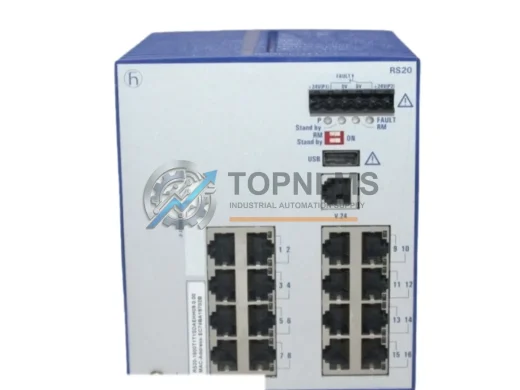
Product Overview
HIRSCHMANN MM2-4TX1 Original Industrial Spare MICE Compatible: System Stability Through Verified Spare Parts
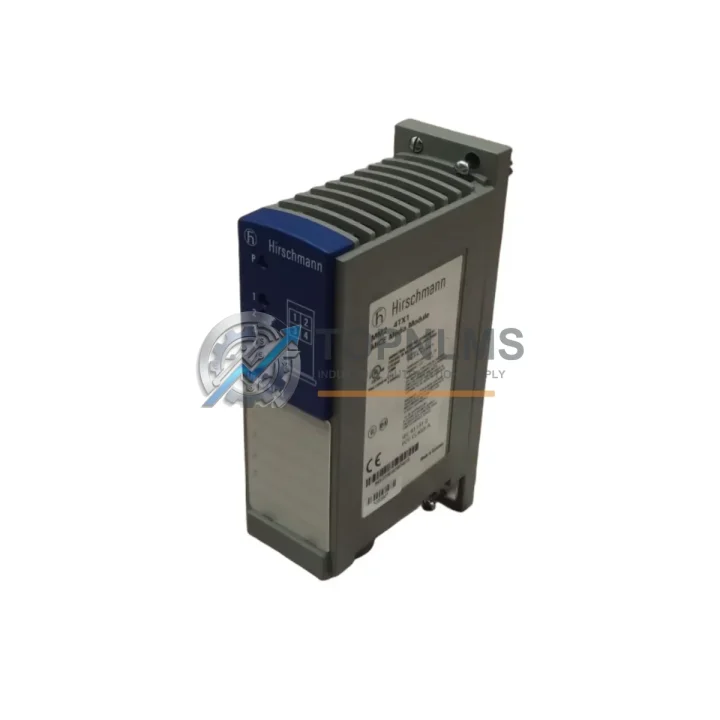
In industrial automation environments, network infrastructure reliability is as critical as the control logic itself. The HIRSCHMANN MM2-4TX1 is an original MICE Series media module designed for managed industrial Ethernet switches, providing copper-to-fiber media conversion within the MICE modular switch platform. Maintaining a verified spare of the MM2-4TX1 is a foundational element of any serious preventive maintenance program for facilities running HIRSCHMANN-based industrial Ethernet backbones.
Whether your plant operates continuous process lines, discrete manufacturing cells, or hybrid SCADA-driven systems, an unplanned network segment failure caused by a degraded or failed media module can cascade into full production stoppage. The MM2-4TX1 eliminates that risk by providing a direct, plug-compatible replacement that restores network topology without reconfiguration, firmware re-flashing, or system re-commissioning.
Critical Technical Specs
| Parameter |
Specification |
| Part Number / SKU |
MM2-4TX1 |
| Brand |
HIRSCHMANN (Belden) |
| Series |
MICE (Modular Industrial Communication Equipment) |
| Module Type |
Media Module – 4× RJ45 TX + 1× Fiber Uplink |
| Interface Ports |
4× 10/100BASE-TX (RJ45) + 1× 100BASE-FX (fiber) |
| Transmission Speed |
10/100 Mbps auto-negotiation |
| Fiber Standard |
100BASE-FX, multi-mode |
| Compatible Platform |
HIRSCHMANN MICE Switch Series (MS20, MS30, PowerMICE) |
| Installation |
Hot-swap module, DIN rail chassis mount |
| Operating Temperature |
-10 °C to +60 °C |
| Protection Class |
IP20 |
| Country of Origin |
Germany |
| Compliance |
CE, UL, IEC 61850 compatible environment |
| Warranty |
12 Months – Tested & Verified Before Shipment |
Preventive Maintenance Strategy
When scheduling a planned shutdown or conducting a routine control cabinet inspection on a HIRSCHMANN MICE-based network, the MM2-4TX1 should never be evaluated in isolation. Industrial Ethernet infrastructure is a system — and the reliability of each segment depends on the health of every interconnected component.
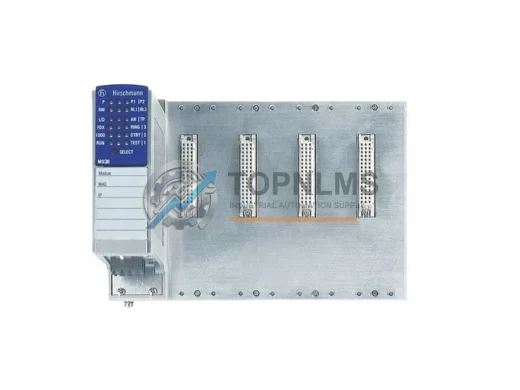
During a fiber segment inspection, maintenance engineers should simultaneously verify the condition of the HIRSCHMANN MICE MS20 or MS30 switch chassis hosting the MM2-4TX1 module. Chassis backplane contacts and module locking mechanisms degrade over time in high-vibration environments. If the chassis shows signs of corrosion or mechanical wear, replacing the media module alone will not restore long-term stability.
The fiber uplink on the MM2-4TX1 connects to the broader plant network via multi-mode fiber patch cables (SC or ST connectors) — these cables are a frequent source of intermittent link failures and should be inspected and cleaned during every scheduled maintenance window. Dirty or cracked fiber connectors account for a disproportionate share of unexplained network dropouts in industrial settings.
On the copper side, the four RJ45 ports feed field devices, remote I/O stations, or sub-panels. This makes the terminal blocks and patch panels in the same cabinet a natural co-inspection target. Loose terminations on structured cabling connected to the MM2-4TX1’s TX ports can introduce packet loss that mimics module failure, leading to unnecessary replacements.
For facilities running PROFINET or Modbus TCP over the MICE network, the HIRSCHMANN SPIDER II unmanaged switches used at machine-level drops are also worth stocking as spares. These compact switches are often the last hop before a servo drive, frequency inverter, or remote I/O module — and their failure isolates entire machine cells from the control network.
Power supply integrity is another critical factor. The MICE switch chassis is typically powered by a 24 VDC DIN rail power supply (PULS, Phoenix Contact, or WAGO equivalents are common). A failing PSU with marginal output voltage causes intermittent module resets that are extremely difficult to diagnose without a spare on hand. Including a redundant PSU in your spare parts inventory alongside the MM2-4TX1 is a best practice for any Tier 1 production line.
If your facility uses HIRSCHMANN RSP (Rapid Spanning Tree Protocol) ring topology, the HIRSCHMANN MACH 1000 or MACH 4000 series backbone switches that anchor the ring should also be part of your critical spare inventory. A failed ring node can degrade the entire network to a linear topology, eliminating redundancy until the fault is resolved.
Finally, for plants with mixed copper and fiber infrastructure, signal isolators and surge protection modules installed on Ethernet lines entering field cabinets from outdoor or long-distance runs should be inspected annually. These devices protect the MM2-4TX1 and the switch chassis from transient overvoltage events that are common in heavy industrial environments with large motor loads.
Strategic Replacement Solutions
The MM2-4TX1 is a direct plug-in replacement for degraded or end-of-life media modules within the HIRSCHMANN MICE platform. Because it is a modular hot-swap component, replacement can be performed without powering down the entire switch chassis — minimizing network disruption to a matter of seconds rather than requiring a full maintenance window.
For facilities still operating legacy MICE configurations originally commissioned in the early 2000s, sourcing original HIRSCHMANN modules has become increasingly difficult through standard distribution channels. TOPNLMS maintains verified stock of original MM2-4TX1 units, each tested for electrical integrity and optical performance prior to shipment. This ensures that replacement units perform identically to factory-new modules without requiring any configuration changes to the managed switch.
Compared to third-party or counterfeit alternatives, original HIRSCHMANN MM2-4TX1 modules maintain full compatibility with HIRSCHMANN’s HiVision network management software, preserving SNMP monitoring, port statistics, and fault alerting capabilities that are essential for proactive network management in critical production environments.
Stocking one or two MM2-4TX1 units as on-site cold spares is a cost-effective strategy that eliminates the lead time risk associated with emergency procurement. Given the module’s role in maintaining fiber uplink connectivity for entire network segments, the cost of a spare is negligible compared to the cost of a single hour of unplanned downtime on a modern production line.
Support FAQ
Q1: Is the MM2-4TX1 compatible with all HIRSCHMANN MICE switch models?
The MM2-4TX1 is designed for the HIRSCHMANN MICE modular switch platform, including MS20, MS30, and PowerMICE chassis variants. Compatibility should be verified against your specific chassis generation and firmware version. Our technical team can assist with compatibility confirmation prior to order.
Q2: How is the MM2-4TX1 tested before shipment?
Every unit undergoes electrical continuity testing, optical port verification, and visual inspection for connector and PCB integrity before dispatch. Units that do not pass all checks are not shipped. A test report is available upon request for critical infrastructure procurement.
Q3: What is the warranty coverage and what does it include?
All MM2-4TX1 units are covered by a 12-month warranty from the date of shipment. The warranty covers manufacturing defects and functional failures under normal operating conditions. DOA (Dead on Arrival) units are replaced or refunded promptly upon confirmation.
Q4: Can I order multiple units for inventory stocking purposes?
Yes. Bulk and multi-unit orders are supported with volume pricing available for qualified buyers. For spare parts inventory programs, blanket orders and staged delivery can be arranged. Contact us at [email protected] to discuss your stocking requirements.