Product Overview
Bently Nevada 330106-05-30-50-02-05 Original Industrial Spare 3300/16: System Stability and Maintenance Value
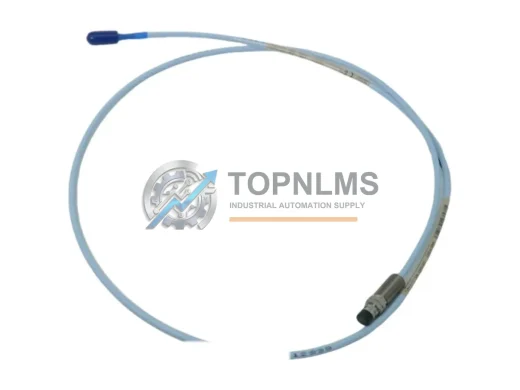
In high-stakes industrial environments — rotating machinery, turbines, compressors, and critical drive trains — the integrity of your vibration monitoring system is non-negotiable. The Bently Nevada 330106-05-30-50-02-05 is an original eddy current proximity probe engineered for the 3300/16 Transducer System, delivering precise, non-contact displacement measurement that forms the backbone of predictive maintenance programs worldwide. Whether you are managing a planned shutdown, responding to an unplanned trip, or building a strategic spare parts inventory, sourcing a genuine replacement probe is the single most important step to restoring system confidence and minimizing downtime risk.
The 330106-05-30-50-02-05 is a field-proven component used across petrochemical plants, power generation facilities, steel mills, and offshore platforms. Its eddy current sensing principle provides continuous, real-time shaft position and vibration data to the 3300/16 monitor rack, enabling operators to detect imbalance, misalignment, oil whirl, and rub conditions before they escalate into catastrophic failures. Replacing this probe with a genuine Bently Nevada original — rather than an uncertified substitute — ensures that calibration coefficients, sensitivity ratings, and gap voltage specifications remain within the system’s validated operating envelope.
Critical Technical Specs
| Parameter |
Specification |
| Part Number |
330106-05-30-50-02-05 |
| Brand |
Bently Nevada (Baker Hughes) |
| Series |
3300/16 XL Proximity Transducer System |
| Sensor Type |
Eddy Current Proximity Probe |
| Probe Length |
5 mm tip diameter, 300 mm cable length (per SKU suffix) |
| Sensitivity |
7.87 V/mm (200 mV/mil) nominal |
| Linear Range |
0.25 mm – 2.26 mm (10 – 89 mil) |
| Operating Temperature |
-35°C to +177°C (probe body) |
| Supply Voltage |
-24 VDC (via 3300/16 driver) |
| Output Signal |
DC voltage proportional to gap distance |
| Target Material Compatibility |
AISI 4140 steel (standard); other alloys require recalibration |
| Connector Type |
Integral coaxial cable with MIL-spec connector |
| Ingress Protection |
Suitable for oil mist, high-humidity, and high-vibration environments |
| Certifications |
CE, ATEX (consult datasheet for zone classification) |
| Compatible Driver |
Bently Nevada 3300/16 Driver (e.g., 330180-X1-05) |
| Compatible Monitor |
Bently Nevada 3300/16 Monitor Rack, 3500 Series Rack |
| Origin |
USA |
| Warranty |
12 Months from date of shipment |
Preventive Maintenance Strategy
A proximity probe failure rarely occurs in isolation. In most industrial facilities, the 3300/16 transducer system is one node in a broader condition monitoring architecture. When a maintenance team is dispatched to replace a 330106-05-30-50-02-05 probe, experienced reliability engineers use the opportunity to audit the entire measurement chain and adjacent systems — a practice that dramatically reduces the probability of a repeat trip or secondary failure within the same maintenance window.
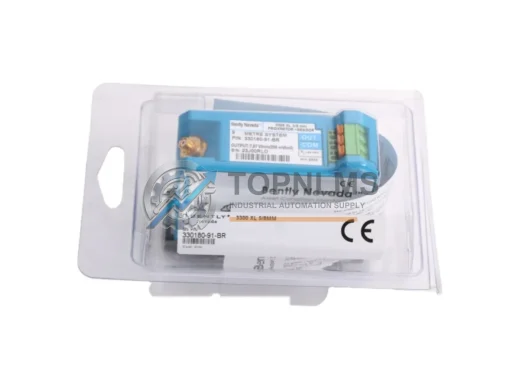
Begin with the 3300/16 driver module (typically a 330180-series unit). The driver converts the probe’s oscillator signal into a calibrated DC output; a worn or moisture-contaminated driver can produce erratic gap voltage readings even with a new probe installed. Inspect the driver’s terminal block connections and verify the output voltage at the nominal gap before closing the cabinet.
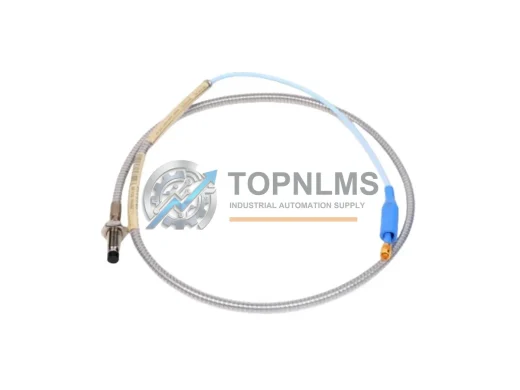
Next, examine the extension cable connecting the probe to the driver — commonly a Bently Nevada 330130-series cable. Extension cables are frequently overlooked during routine inspections, yet they are among the most failure-prone components in the transducer chain due to mechanical flexing, chemical exposure, and connector corrosion. A cracked or intermittently open extension cable will produce noise spikes that mimic real shaft vibration events, leading to nuisance trips.
While the control cabinet is open, inspect the 3300/16 monitor card and its rack backplane connectors. Loose card-edge connections and oxidized backplane pins are a common source of intermittent channel faults. If the facility operates a Bently Nevada 3500 Series rack, verify that the I/O module termination boards are seated correctly and that the rack power supply module — such as a 3500/15 Power Supply — is delivering stable ±24 VDC rails.
For facilities running parallel vibration monitoring on multiple machine trains, it is best practice to maintain a minimum stock of 3300 XL 8mm proximity probes (330103-series) alongside the 5mm variants, as many plants operate mixed probe diameter configurations on different bearing housings. Similarly, Keyphasor probes (330980-series) used for phase reference measurement should be inspected and stocked as a matched set with the radial probes, since a failed Keyphasor will disable vector and spectrum analysis across the entire machine train.
Do not overlook the signal conditioning and I/O interface layer. If the 3300/16 output feeds into a DCS or safety instrumented system via a signal isolator or barrier — such as a Pepperl+Fuchs or MTL zener barrier — verify that the barrier’s working voltage and current limits are still within specification. Degraded barriers introduce offset errors that shift the apparent gap voltage and can cause false alarm conditions.
Finally, review the grounding and shielding topology of the entire transducer loop. Eddy current systems are highly sensitive to ground loops; a single improper shield termination at a junction box or marshalling cabinet can introduce 50/60 Hz interference that corrupts vibration waveforms. Confirm that cable shields are terminated at one end only, per Bently Nevada installation guidelines, and that the machine casing ground is bonded to the instrument earth bus with a low-impedance connection.
Strategic Replacement Solutions
The Bently Nevada 3300/16 system has been in continuous production and field deployment for decades, and many facilities are operating probes that have exceeded their recommended service life of 5–7 years in harsh environments. The 330106-05-30-50-02-05 is a direct original replacement that requires no recalibration of the monitor system, no modification of alarm setpoints, and no changes to the DCS tag configuration — making it the lowest-risk, fastest-path-to-restoration option available.
For facilities managing end-of-life machinery where the original 3300/16 rack is no longer supported under an OEM service contract, the original probe remains the correct choice as long as the driver and monitor hardware are functional. Substituting a non-OEM probe with a different sensitivity coefficient or a different cable impedance will shift the system’s calibration and may cause the monitor to report incorrect vibration amplitude values — a compliance risk in API 670-governed installations.
Procurement teams managing multi-site spare parts programs should consider stocking the 330106-05-30-50-02-05 in quantities of 2–4 units per machine train monitored, in line with API 670 Annex D recommendations for critical machinery spares. Probes stored in original packaging in a climate-controlled environment maintain their calibration and mechanical integrity for 5+ years, making forward stocking a cost-effective strategy compared to emergency procurement during an unplanned outage.
All units supplied by TOPNLMS are sourced from authorized distribution channels, individually inspected prior to shipment, and covered by a 12-month warranty against manufacturing defects. Each probe is shipped in original OEM packaging with full traceability documentation available upon request.
Support FAQ
Q1: Is the 330106-05-30-50-02-05 compatible with both the 3300/16 and 3500 Series monitor racks?
A: The probe is natively designed for the 3300/16 Transducer System. It is also compatible with the Bently Nevada 3500 Series rack when used with the appropriate 3500/42 Proximitor I/O module and a matched 3300/16 driver. Always verify the driver part number and sensitivity setting in the monitor configuration before installation.
Q2: How do I verify the probe is functioning correctly after installation?
A: Set the probe gap to the nominal value specified in the machine’s vibration monitoring datasheet (typically 1.0–1.5 mm for most bearing housings). Measure the driver output voltage with a calibrated multimeter and confirm it falls within the linear range (approximately -10 VDC at nominal gap for a 7.87 V/mm probe). Compare the reading against the original commissioning record. If the output is outside the expected range, inspect the extension cable and driver before concluding the probe is defective.
Q3: What is the recommended spare parts stocking strategy for this probe?
A: For critical rotating machinery (API 670 Category I), maintain a minimum of 2 spare probes per machine train in on-site inventory. For non-critical or Category II machines, a regional warehouse stock of 1–2 units is typically sufficient. Probes should be stored in original sealed packaging at 15–35°C with relative humidity below 75% (non-condensing).
Q4: Does TOPNLMS provide pre-shipment testing and warranty coverage?
A: Yes. Every 330106-05-30-50-02-05 unit is inspected for physical integrity and connector condition before dispatch. A 12-month warranty is provided from the date of shipment, covering manufacturing defects. Units are shipped with standard export packaging suitable for international freight. Expedited shipping options are available for urgent maintenance requirements. Contact us at [email protected] or +86 18359293191 for lead time and availability.