Product Overview
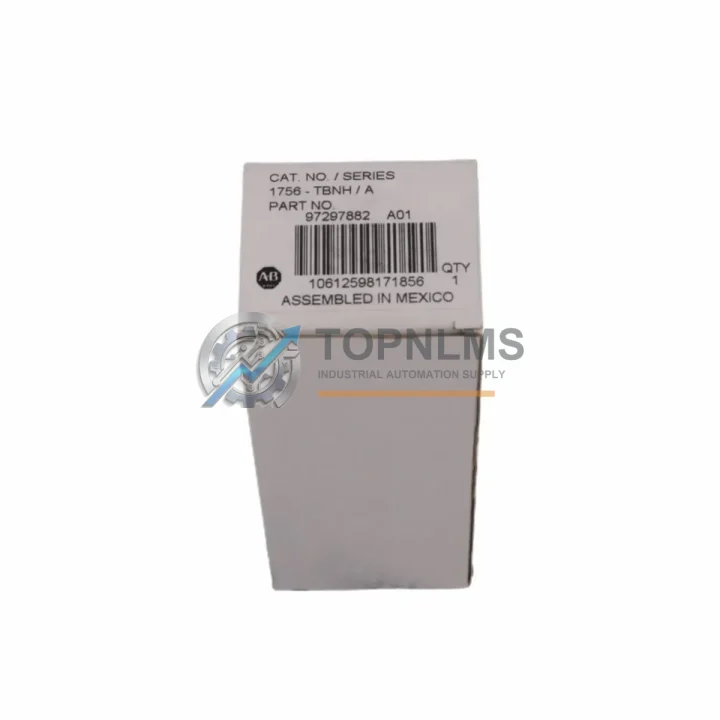
Allen-Bradley 1756-TBNH Replacement for ControlLogix I/O: Seamless Migration & Smooth Transition
When your legacy ControlLogix system requires a terminal block replacement or your existing 1756-TBNH has reached end-of-service life, sourcing a verified, drop-in compatible unit is critical to minimizing plant downtime. The Allen-Bradley 1756-TBNH is a 20-pin screw-type terminal block designed specifically for the 1756 I/O module family, providing a reliable field-wiring interface for digital and analog I/O modules within the ControlLogix platform. Whether you are executing a planned maintenance swap, responding to an unplanned failure, or modernizing an aging control cabinet, this unit delivers the wiring compatibility and mechanical fit your system demands.
The 1756-TBNH connects directly to ControlLogix I/O modules such as the 1756-IB16, 1756-OB16E, 1756-IF8, and 1756-OF8 without any rewiring of field cables. The screw-terminal design accommodates standard 14–22 AWG conductors, preserving your existing field wiring infrastructure and eliminating the need for re-termination during a module swap. This is particularly valuable in retrofit scenarios where the control cabinet layout is fixed and re-routing cables would introduce significant labor cost and risk.
Compatibility Comparison Table
| Parameter |
Legacy / Replaced Unit |
1756-TBNH (This Unit) |
| Part Number |
1756-TBNH (worn / EOL unit) |
1756-TBNH (new replacement) |
| Terminal Type |
20-pin screw terminal |
20-pin screw terminal |
| Compatible I/O Modules |
1756-IB16, 1756-OB16E, 1756-IF8, 1756-OF8, 1756-IA16, 1756-OA16 |
Same — direct drop-in fit |
| Wire Gauge |
14–22 AWG |
14–22 AWG |
| Mounting |
Front-mount, module-clip latch |
Front-mount, module-clip latch |
| Communication Protocol |
N/A (passive terminal block) |
N/A (passive terminal block) |
| Rack / Backplane |
1756 ControlLogix chassis |
1756 ControlLogix chassis |
| Installation Space |
Standard 1756 I/O module footprint |
Identical footprint — no cabinet modification |
| Replacement Recommendation |
Direct swap; no rewiring required |
✔ Confirmed drop-in replacement |
| Warranty |
— |
12-Month Warranty |
Seamless Upgrade Solutions
A successful ControlLogix migration or I/O module replacement rarely involves a single component. In practice, engineers upgrading from older 1756-series hardware or migrating from legacy PLC-5 and SLC 500 platforms to the ControlLogix architecture will encounter a coordinated set of component changes across the control cabinet.
When replacing I/O modules such as the 1756-IB16 digital input module or the 1756-OB16E digital output module, the 1756-TBNH terminal block is the standard field-wiring interface that must be replaced or verified alongside the module itself. In analog signal loops, the 1756-IF8 analog input module and 1756-OF8 analog output module use the same 20-pin terminal block family, making the 1756-TBNH a common spare across multiple I/O types in a single chassis.
For systems where the 1756 ControlLogix chassis (such as the 1756-A7 or 1756-A13) is being expanded or reconfigured, the 1756-TBNH is typically ordered in multiples to match the number of I/O slots being populated. Engineers should also verify the 1756-PA72 or 1756-PB72 power supply module is correctly rated for the expanded chassis load when adding I/O modules during a retrofit.
In migration projects moving from PLC-5 or SLC 500 architectures, the 1747-SCNR ScanPort adapter or 1756-DHRIO Data Highway Plus / Remote I/O communication module may be retained in the new ControlLogix rack to maintain legacy device communication during a phased cutover. The 1756-TBNH terminal blocks on the new I/O modules can be pre-wired and tested offline before the final cutover, significantly reducing live-system exposure time.
For projects involving remote I/O expansion over EtherNet/IP, the 1756-EN2T or 1756-EN2TR Ethernet communication module is commonly installed in the same chassis. Ensuring that the I/O modules paired with 1756-TBNH terminal blocks are correctly mapped in the RSLogix 5000 or Studio 5000 Logix Designer project file is a standard commissioning step that should be completed and verified before field wiring is connected.
In control cabinets where signal isolation is required between field devices and the ControlLogix I/O, DIN-rail mounted signal isolators or terminal relay modules are often installed between the field cable terminations and the 1756-TBNH screw terminals. This is common in applications involving 4–20 mA analog loops, thermocouple inputs, or high-voltage discrete signals that exceed the I/O module’s rated input range.
Retrofit Guidance FAQ
Q: Can I reuse my existing field wiring when replacing the 1756-TBNH?
A: Yes. The 1756-TBNH uses the same 20-pin screw-terminal layout as the original unit. Field wires can be transferred terminal-by-terminal using the existing wiring diagram without any changes to conductor routing or labeling.
Q: Do I need to modify my RSLogix 5000 / Studio 5000 program when replacing the terminal block?
A: No. The 1756-TBNH is a passive wiring interface with no electronic components or firmware. Replacing it does not affect the controller program, I/O tags, or module configuration in Studio 5000 Logix Designer.
Q: Is the 1756-TBNH compatible with both digital and analog 1756 I/O modules?
A: The 1756-TBNH is compatible with specific 1756 I/O modules that use the 20-pin screw-terminal interface. Always verify the terminal block catalog number against the I/O module’s installation instructions to confirm compatibility before ordering.
Q: Will this terminal block fit in my existing control cabinet without modification?
A: Yes. The 1756-TBNH attaches directly to the front face of the 1756 I/O module and does not require additional DIN rail space or cabinet modification. The physical footprint is identical to the original unit.
Q: What communication protocols are supported?
A: The 1756-TBNH is a passive terminal block and does not participate in any communication protocol. Protocol compatibility (EtherNet/IP, ControlNet, DeviceNet, DH+) is determined by the communication modules installed in the 1756 chassis, not by the terminal block.
Q: How do I verify the correct terminal block catalog number for my I/O module?
A: Refer to the I/O module’s installation instructions (available from Rockwell Automation) or the module label, which lists the compatible terminal block catalog numbers. The 1756-TBNH is the standard 20-pin screw-terminal option for the applicable module family.
Warranty Assurance
Every 1756-TBNH unit shipped from TOPNLMS is covered by a 12-month warranty from the date of delivery. Prior to shipment, each unit undergoes a physical inspection covering terminal integrity, latch mechanism function, pin alignment, and housing condition. Units that do not meet our quality standards are quarantined and not shipped.
In the event of a confirmed defect within the warranty period, TOPNLMS will arrange a replacement unit at no additional cost. Our after-sales response target is one business day for warranty claims submitted via email. We maintain stock of common ControlLogix spare parts to support rapid replacement dispatch, minimizing the impact on your production schedule.
For procurement teams requiring documentation, we can provide a packing list, commercial invoice, and certificate of conformance upon request. Bulk orders for MRO inventory programs are welcome, and we can discuss consignment or scheduled delivery arrangements for high-volume customers.
All units are securely packaged for international freight and can be shipped via DHL, FedEx, or UPS Express to minimize transit time. Export documentation for customs clearance is prepared in accordance with the destination country’s import requirements.