Product Overview
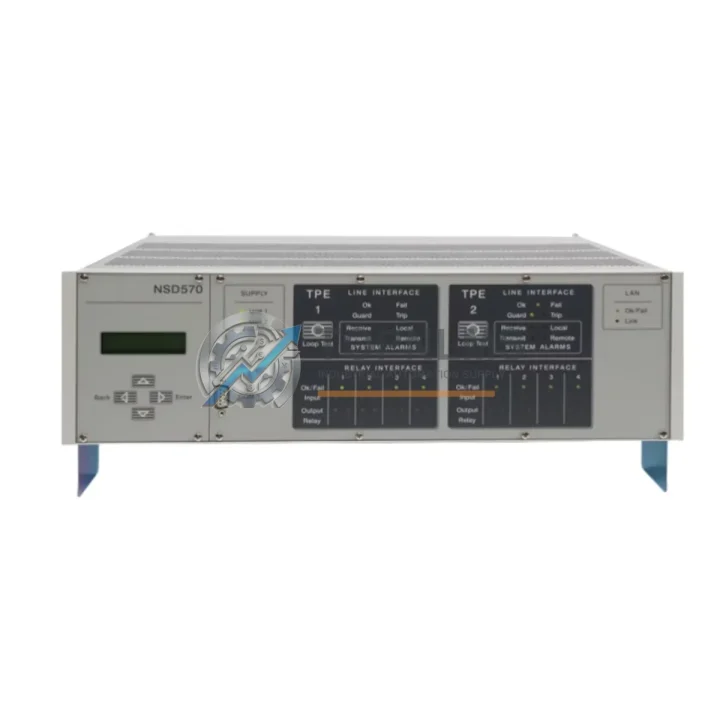
ABB NSD570 Original Industrial Spare NSD570 Series Compatible: Ensuring Grid System Stability Through Reliable Teleprotection
In high-voltage substation environments and transmission grid control systems, the ABB NSD570 Digital Teleprotection Terminal is a mission-critical component that cannot afford unplanned downtime. As an original spare part sourced directly from verified supply channels, the NSD570 provides the same factory-grade performance as the installed unit — ensuring seamless drop-in replacement without reconfiguration overhead or compatibility risk. For maintenance engineers managing aging protection relay panels, having a pre-tested NSD570 unit on the shelf is not a luxury; it is a fundamental element of a resilient grid protection strategy.
The NSD570 is designed for use in differential protection schemes, distance protection backup, and inter-substation teleprotection signaling across power line carrier (PLC), fiber optic, and microwave communication channels. Its role in the protection chain means that a failed or degraded unit can compromise the entire line protection scheme, potentially leading to delayed fault clearance, cascading trips, or regulatory non-compliance. Sourcing a verified original replacement unit in advance eliminates this exposure entirely.
Critical Technical Specs Table
| Parameter |
Specification |
| Model / SKU |
NSD570 |
| Brand |
ABB |
| Series |
NSD570 Digital Teleprotection Series |
| Product Type |
Digital Teleprotection Terminal |
| Communication Interfaces |
PLC (Power Line Carrier), Fiber Optic, Microwave / E1 |
| Protection Functions |
Teleprotection signaling, inter-trip, permissive overreach, blocking schemes |
| Signal Channels |
Up to 8 independent protection signal channels |
| Operating Voltage |
48 VDC / 110 VDC / 220 VDC (model-dependent) |
| Operating Temperature |
-10°C to +55°C |
| Mounting |
19-inch rack mount / panel mount |
| Country of Origin |
Germany |
| Compatibility |
ABB NSD570 Series; compatible with existing NSD570 relay panels and communication infrastructure |
| Application Environment |
HV/EHV substations, transmission line protection, grid control rooms |
| Maintenance Recommendation |
Inspect signal integrity and channel loopback annually; replace degraded units proactively |
| Warranty |
12 Months — Tested, inspected, and verified before shipment |
Preventive Maintenance Strategy
A structured preventive maintenance program for substation protection systems must extend well beyond the NSD570 terminal itself. During scheduled outages or annual relay panel inspections, maintenance teams should treat the NSD570 replacement as part of a broader protection system audit. When the NSD570 is pulled for testing or replacement, it is the ideal time to simultaneously inspect the ABB REL670 distance protection relay, which often operates in the same line protection scheme and shares the same communication infrastructure. A degraded REL670 can mask or amplify faults that the NSD570 is designed to signal, making coordinated inspection essential.
The power supply module feeding the NSD570 rack — typically a 48 VDC or 110 VDC DC/DC converter module — should be load-tested during the same maintenance window. Power supply degradation is a leading cause of intermittent teleprotection signal failures that are difficult to diagnose under normal operating conditions. Alongside the power supply, the terminal block assemblies and wiring harnesses connecting the NSD570 to the protection relay panel should be inspected for corrosion, loose terminations, and insulation breakdown, particularly in humid or coastal substation environments.
For substations using fiber optic communication, the SFP transceivers and fiber patch panels associated with the NSD570’s optical interface should be cleaned and tested for optical power margin. Dirty or degraded fiber connections are a common source of intermittent channel failures that can be misdiagnosed as NSD570 unit faults. If the installation uses E1 or G.703 interfaces, the E1 interface cards and associated coaxial patch panels warrant inspection at the same interval.
In control cabinets housing the NSD570 alongside other protection IEDs, it is good practice to inspect the ABB REB670 busbar protection terminal and any associated binary input/output modules for firmware currency and contact integrity. The binary output relays that carry the NSD570’s trip and permissive signals to the circuit breaker control circuits should be tested for contact resistance and operate time. Relay output modules with elevated contact resistance can introduce dangerous delays in fault clearance even when the NSD570 itself is functioning correctly.
For facilities running ABB’s MicroSCADA or PCM600 protection management platform, the NSD570 replacement should be accompanied by a configuration backup and parameter verification step. Ensuring that the replacement unit is loaded with the correct channel configuration, signal delay settings, and communication parameters before energization eliminates commissioning errors that could leave the line unprotected during the restoration window. Keeping a spare SD card or configuration file archive for the NSD570 is a low-cost insurance policy that dramatically reduces restoration time during emergency replacements.
Inventory planners managing multi-substation portfolios should consider stocking at least one NSD570 unit per communication technology variant (PLC, fiber, microwave) to cover the full range of installed configurations. Pairing this with a spare ABB COMBIFLEX relay output module and a set of pre-terminated fiber patch cords ensures that a complete channel restoration can be executed within a single maintenance shift, minimizing the window during which line protection is degraded.
Strategic Replacement Solutions
The ABB NSD570 has been in service across global transmission networks for over two decades, and many installations are now operating on aging units that are approaching or exceeding their recommended service life. Original replacement units sourced through verified supply channels offer the only path to maintaining full OEM compatibility without the risk and cost of a full protection scheme redesign. Unlike third-party alternatives or refurbished units of uncertain provenance, an original NSD570 spare maintains the factory-calibrated signal timing and channel integrity that protection coordination studies are based on.
For substations where the NSD570 is being replaced as part of a broader protection upgrade, the original spare provides a critical bridge solution — maintaining existing teleprotection functionality while the wider upgrade project is planned and budgeted. This approach avoids the operational risk of running a substation without teleprotection during extended procurement or engineering lead times, which can stretch to 12–24 months for full protection system replacements.
Facilities transitioning from older ABB NSD500 or NSD510 series terminals to the NSD570 platform will find that the NSD570’s backward-compatible communication modes simplify the migration path, allowing phased replacement of terminals at both ends of a protected line without requiring simultaneous cutover. This staged approach reduces outage requirements and allows maintenance teams to validate channel performance at each step before proceeding.
For maintenance managers operating under tight capital budgets, the NSD570 original spare represents a significantly lower total cost of ownership than an emergency procurement under outage conditions, where expedited freight, after-hours engineering support, and extended outage costs can multiply the effective cost of a replacement unit by a factor of five or more. Pre-positioning a verified spare eliminates this exposure entirely.
Support FAQ
Q1: How do I verify that a replacement NSD570 unit is compatible with my existing installation?
Compatibility is determined by the communication interface type (PLC, fiber optic, or microwave/E1), the operating voltage variant, and the firmware version. Before ordering, confirm the interface type and DC supply voltage of your installed unit from the nameplate or the original commissioning documentation. Our team can assist with compatibility verification based on your existing unit’s serial number or order reference.
Q2: What does the 12-month warranty cover, and what testing is performed before shipment?
Every NSD570 unit is functionally tested prior to shipment, including power-on verification, channel loopback testing, and signal integrity checks. The 12-month warranty covers manufacturing defects and functional failures under normal operating conditions. Units are shipped with test records available on request.
Q3: How quickly can a replacement NSD570 be installed in the field?
For a like-for-like replacement where the configuration parameters are documented, an experienced protection engineer can complete the physical swap and recommissioning within a single maintenance shift (4–8 hours), including channel testing and sign-off. Having the configuration file backed up in advance reduces this window significantly.
Q4: What is the recommended inventory strategy for NSD570 spares across a multi-substation portfolio?
Industry best practice for critical teleprotection terminals is to maintain one spare unit per communication technology variant per 5–10 installed units, with a minimum of one spare per substation for high-criticality lines. For portfolios with mixed PLC and fiber installations, stocking one unit of each interface type provides coverage for the most common failure scenarios without excessive inventory carrying cost.