
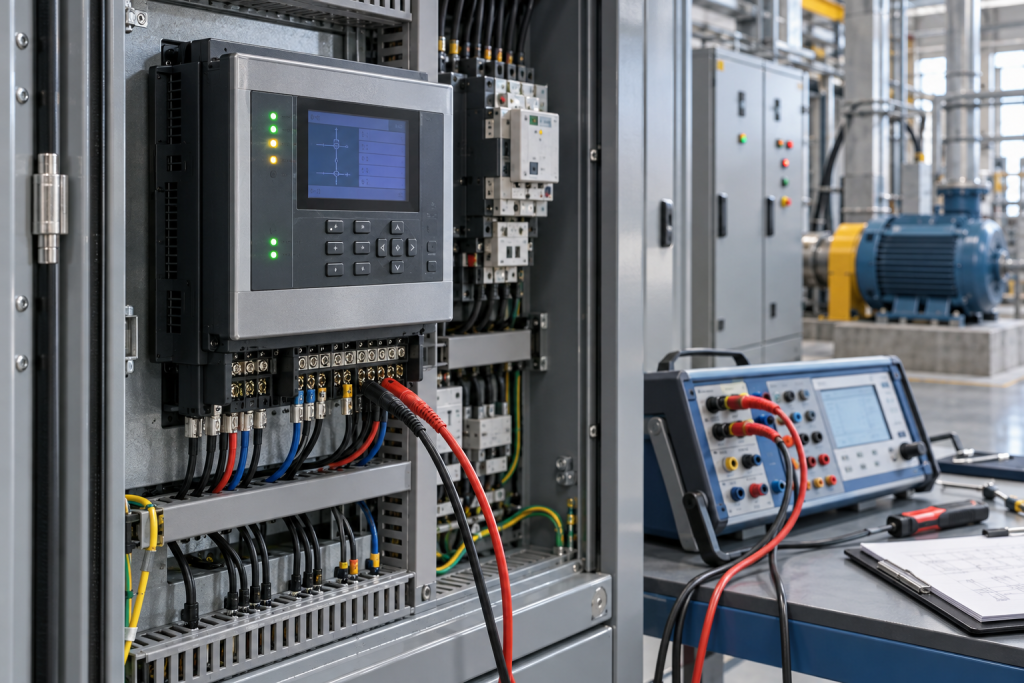
A motor protection relay is often replaced after a trip because it is the most visible device in the event record. That is understandable, but dangerous. The relay may have operated correctly for an overload, locked rotor, phase loss, ground fault or process condition. If the plant replaces it before preserving the trip data, the evidence that protects the next motor and the next maintenance decision may be gone.
GE Multilin 469 and 369 installations sit in a wider protection chain: CTs, VTs, contactors, breakers, motor, load, control logic and trip wiring. Spare planning should preserve the decision path, not simply hold a relay with a similar front panel.
Capture the relay before resetting
Record the relay model, order code, firmware, motor nameplate, CT ratio, VT arrangement, trip date, current values, event record, pickup settings and output contacts. Photograph terminal wiring and the relay display. Download settings and event files through the authorized procedure. Note the motor load, ambient condition, restart attempts and upstream breaker status.
Do not reset a critical trip before operations and engineering agree on the evidence to retain. A reset may clear useful history. The relay is part of the incident record even if it is later found healthy.
Separate relay, CT and motor causes
Compare measured currents, phase balance, residual current, thermal model and event timing. Check CT polarity, shorting terminals, wiring, motor insulation, bearings, load alignment and breaker operation under the site’s safe procedures. A protection relay can report a real motor problem, and a wiring fault can create a false one.
The GE Multilin 469-P5-HI-A20 relay should be matched to motor application, CT inputs, communication, firmware and the installed trip logic. Ask whether the unit is new, tested used or repaired, and require the actual test scope. A power-up display does not prove the protection functions.
The GE Multilin 369-HI-R-M motor management relay may serve a different application and must not be treated as a generic substitute. Compare rating, input configuration, protection elements, output arrangement and panel cutout before procurement approves a cross-reference.
Define a protection acceptance test
For a critical relay, state the required checks: power-up, display and keypad, settings load, CT or simulator inputs, trip outputs, alarms, communications and event capture. Use a qualified test set or approved simulator where possible. Record injection values, pickup times and what was not tested. This is the difference between a verified spare and a shelf item.
At installation, confirm settings against the approved file, CT wiring, output contacts, breaker trip path, motor data, alarms, communications and historian points. Perform the site proof test under the plant’s protection procedure. Check both normal indication and the approved trip path. Keep the removed relay tagged until the root-cause review closes.
Motor protection spares should also be reviewed with the motor criticality list. A relay protecting a cooling-water pump, compressor or process fan may justify tested bridge stock; a low-consequence auxiliary may justify a different strategy. Include the repair lead time and availability of a qualified test facility.
Use the event report to update the maintenance plan. If the relay operated correctly, the action may belong in motor or process maintenance rather than procurement. If the relay or CT path failed, record the specific evidence so the next RFQ and proof test are stronger.
Keep the approved settings file with the motor record and note who can authorize a change. A relay that is replaced with an older file may appear healthy while applying the wrong pickup or delay. The settings, CT ratio and trip wiring are part of the spare acceptance, not paperwork to be completed after the motor is restarted.
For a planned proof test, agree in advance how the motor will be isolated and how the breaker trip path will be observed. Record the test instrument, injection values, relay response and restoration checks. A clear test record protects both the equipment and the person approving the return to service.
Review repeated trips with operations and reliability. If the relay is operating correctly, lowering the setting may create a safety problem rather than a solution. The right action may be mechanical inspection, process correction, CT repair or a scheduled motor intervention.
This review also tells procurement whether another relay is needed or whether the motor itself is the priority.
Questions maintenance teams usually ask
Should we replace the relay after every motor trip?
No. Preserve the event, settings, CT evidence and motor condition first. The relay may have made the correct protection decision.
Is a similar Multilin model a safe substitute?
Not without checking application, inputs, protection elements, outputs, firmware, communications and the approved trip logic.
What proves a relay spare is ready?
Documented power-up, settings load, simulated inputs, output behavior, communications and test limits, with site proof testing still defined.
What should an urgent relay RFQ include?
Send exact model, order code, motor data, CT ratio, settings, trip evidence, photos, quantity, condition expectation and required date.
Protect the trip decision, not only the relay
Motor protection becomes more reliable when the plant preserves the evidence that led to the trip. Exact model matching and a real proof test then support both urgent recovery and better reliability decisions.
Send the relay label, event record, motor details and outage timing to TOPNLMS. We can help verify the match and prepare a focused quotation.
© 2026 TOPNLMS. All rights reserved. Official Website: https://topnlms.com Inquiry: [email protected] | WhatsApp/Tel: +86 187 5021 5667