
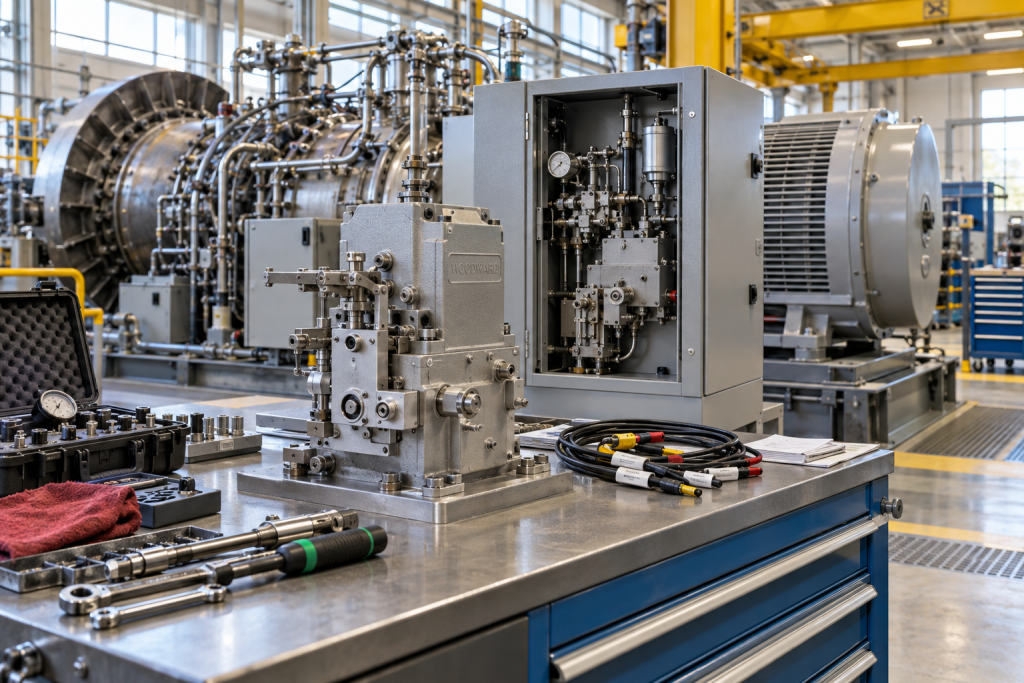
A generator governor can pass a visual inspection and still create an unstable startup. The control module sits inside a larger speed-control loop that includes the pickup, actuator, fuel or steam mechanism, wiring, power supply and tuning. When a plant orders a replacement without recording that loop, the first start may become the commissioning test, which is an expensive place to discover a mismatch.
Woodward 2301A and EG governor applications are often kept in service because they are familiar, robust and integrated into proven generator packages. A strong spare plan respects that history while recognizing that lead times, condition labels and undocumented adjustments can make an old system vulnerable.
Capture the governor baseline
Record the exact governor model, part number, application, control power, speed range, actuator type and mounting arrangement. Photograph the terminal side and the surrounding wiring. Note the rated speed, overspeed trip setting, start sequence, normal load response and any manual bias or droop adjustment. If the package has a dedicated speed pickup, record its type, gap and signal condition.
Save the latest commissioning sheet and the last stable operating values. A value written in an old notebook is still useful if it is identified by machine, date and operating condition. Add the generator nameplate, prime mover, fuel system and control mode. These details help distinguish a governor issue from a mechanical or sensor issue.
Separate control, pickup and actuator faults
Begin with power and signal quality. Check control voltage at the governor during cranking and load changes. Inspect the speed pickup cable, shielding, connector and mounting gap. A weak or noisy pickup can look like a governor failure. Check the actuator linkage for friction, travel and mechanical stops before replacing the electronic control.
The Woodward 9907-175 EG governor compatible spare should be matched to the engine and actuator arrangement, not just the “EG” label. Confirm the application, input/output requirements, adjustment range and the condition evidence. Ask whether the unit has been powered and functionally tested, and what the test did not cover.
For a 2301A application, the Woodward 9907-028 2301A compatible spare must be checked against the existing speed-control loop and commissioning procedure. A compatible solution may still require a controlled calibration, and that work should be planned before the outage.
Plan the calibration, not only the purchase
Write the calibration and startup plan before the replacement arrives. Define who can adjust speed, droop, gain, stability and actuator limits. State the instruments required and the safe operating envelope. For a generator that will connect to a grid or parallel with other units, include the load-sharing and synchronization checks.
Bench testing is useful for power-up, diagnostics, terminals and basic signal behavior, but it cannot prove the entire engine response. A replacement should be labeled with the bench-test scope and the live commissioning steps still required. Keep the original governor until the new unit has been accepted and the event record is closed.
Use a startup evidence pack
The evidence pack should contain the governor identity, pickup measurements, actuator travel, control-power readings, initial settings, calibration results, overspeed-trip verification and load-test observations. Record any temporary adjustment and return it to the approved setting after the test. If the machine is unavailable for a full load test, state the limitation rather than treating a no-load run as complete validation.
Store the spare with its photographs, test report and application notes. New, tested used, repaired and exchange stock should be separated in the register. A repair that restores power does not necessarily prove stable speed control. Buyers should request the test scope and any known limitations before approving a critical generator spare.
Keep the original governor tagged until the replacement has completed the approved startup and load checks. The old unit can preserve useful evidence about the original symptom, and it may still be the fastest rollback option if the new controller exposes a tuning or actuator issue.
After acceptance, update the generator maintenance file with the final settings, test instruments, load condition and approving engineer. This makes the next emergency response faster because the team can compare a future symptom with a known-good operating record.
Questions maintenance teams usually ask
Can any Woodward 2301A-compatible unit be installed?
No. Match the prime mover, actuator, pickup, control power, speed range and commissioning procedure. Compatibility must be demonstrated for the application.
Why check the speed pickup before replacing the governor?
A weak, noisy or incorrectly gapped pickup can produce the same symptoms as a governor fault. Proving the signal prevents an unnecessary electronic replacement.
Is bench power-up enough to approve a spare?
No. It proves only the tested functions. The record should identify diagnostics, signal tests and the live calibration or load checks still required.
What belongs in an urgent governor RFQ?
Include the exact part number, application, prime mover, actuator, pickup type, control voltage, quantity, condition requirement, test evidence and destination.
Protect the first start
Governor spare planning is successful when the first startup is a controlled verification rather than a gamble. The module identity, speed signal, actuator condition and calibration data must be treated as one system. That discipline also helps the plant decide whether to hold a complete replacement, a tested controller or a repair route.
Send the governor label, generator details, pickup information and required date to TOPNLMS. We can help identify the Woodward spare, clarify the test scope and prepare a quotation that supports a safe, documented startup.
© 2026 TOPNLMS. All rights reserved. Official Website: https://topnlms.com Inquiry: [email protected] | WhatsApp/Tel: +86 18359293191