
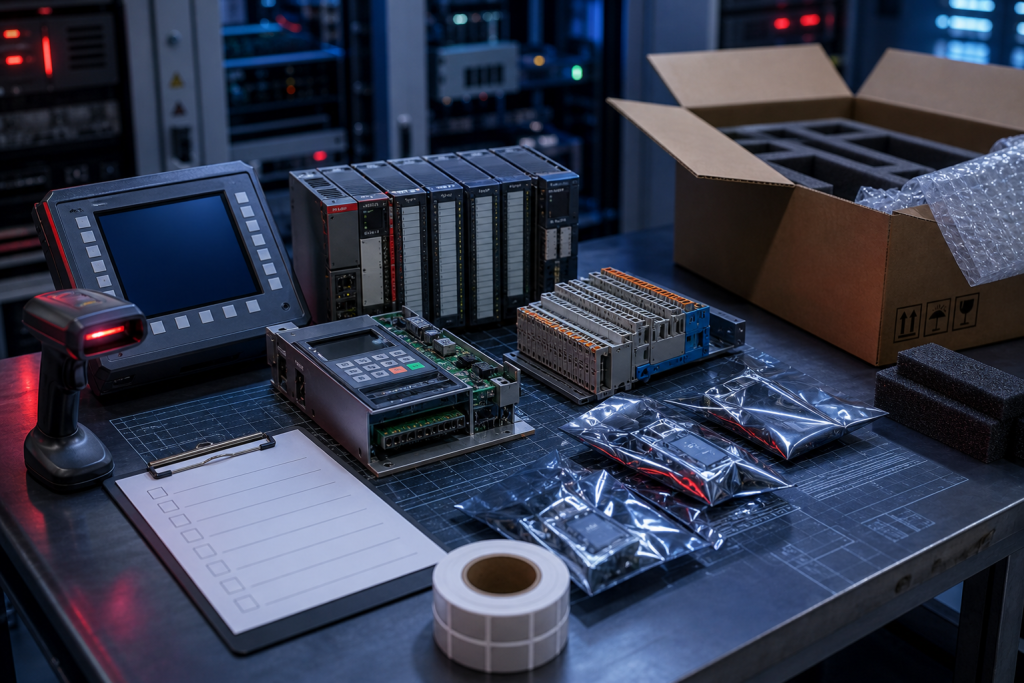
A shutdown spare kit should not be built on the day purchasing asks for price. By then, the maintenance team is already busy, the outage date is close, and every unclear model number creates another delay. TOPNLMS sees this pattern often: a buyer sends a mixed list of PLC modules, HMI panels, VFD boards, relays, and terminal blocks, but the list is missing photos, quantities, condition requirements, or delivery deadlines.
The result is predictable. Suppliers ask for details. Engineering checks cabinets again. The buyer compares prices that may not refer to the same condition or revision. The shutdown window gets closer. A better approach is to prepare the kit before the RFQ is sent, even if the plant is not ready to buy every item immediately.
Separate critical spares from nice-to-have items
Start with consequence. Which part can stop the line, utility, compressor, furnace, packaging cell, or test station? Which part has no local backup? Which part has already shown intermittent faults? These items belong at the top of the shutdown spare kit. Lower-risk accessories can still be listed, but they should not hide the urgent parts.
Group the list by equipment area. For each item, include model number, brand, quantity, installed location, and reason for purchase. “One spare for Line 3 filler HMI” is more useful than “HMI spare.” It tells the sourcing team that the part is tied to a real outage risk and should not be treated like a casual stock enquiry.
TOPNLMS keeps practical notes in the maintenance spares category because shutdown buying is different from normal catalog browsing. The deadline and evidence quality matter as much as the part name.
Photos make the RFQ faster
For every major spare, send a front photo, nameplate photo, connector photo, and installed-location photo. If the part has a firmware screen or revision label, include it. If the part is a board, show both sides if it can be done safely. If the part is a drive or HMI, include power rating, screen size, and communication details.
Do not crop out the surrounding hardware too tightly. A little context helps identify accessories. A PLC module may need a terminal block. A VFD board may require a matching keypad or cable. An HMI may need a mounting clip or communication adapter. These small items can become the reason a shipment is incomplete.
Condition and packing should be clear
State whether the plant accepts factory sealed, new surplus, refurbished, or tested used parts. If the item is for critical shutdown stock, condition expectations should be agreed before the quote. A low price is not helpful if the receiving team later rejects the condition.
For export orders, packing should be part of the RFQ. Ask for anti-static packaging for electronic modules, foam protection for panels and boards, and clear carton labeling. If the shipment contains mixed parts, request a packing list that matches the RFQ line numbers. This makes receiving faster and reduces mistakes during the shutdown.
Use RFQ tips to keep the list simple: exact model, quantity, condition, photos, delivery location, deadline, and any must-match revision. That information is enough to reduce most avoidable delays.
A practical kit also needs ownership. Assign one person to confirm the technical list, one person to handle commercial comparison, and one person to receive and check the shipment. If nobody owns receiving inspection, parts may arrive before the shutdown and still remain unchecked until the day they are needed. A five-minute photo check against the RFQ can catch wrong labels, missing accessories, or packing damage while there is still time to react.
For urgent kits, ask whether split shipment is helpful. Sometimes the most critical PLC or HMI spare should move first while lower-risk accessories follow later. In other cases, splitting the order creates confusion and should be avoided. Tell the supplier which items are shutdown-critical so delivery options can be discussed with the real priority in mind.
The final check is simple: can the maintenance team open the carton and know where each part goes? If the answer is no, add line numbers, equipment names, or cabinet references before the RFQ is finalized. A spare kit should reduce shutdown stress, not create another sorting job beside the machine.
Keep the same structure for future shutdowns. Once the team has a clean kit format, reuse it for the next line, plant, or project. Repeated format is not boring in procurement; it is how buyers get faster answers and fewer avoidable mistakes.
FAQ
How early should we prepare a shutdown spare kit?
Prepare the first list as soon as the shutdown scope is known. Even if purchasing waits, engineering can use the time to confirm models and photos.
Should we include low-risk parts?
Yes, but separate them from critical spares. The supplier should know which items affect the shutdown date and which are optional stock.
What if we do not know the revision?
Send clear label photos and say the revision is unknown. The sourcing team can often help identify it, but guessing should be avoided.
Can one RFQ include many brands?
Yes. A mixed-brand RFQ is common for shutdown work. Keep each line complete with model, quantity, condition, and photo evidence.
Send TOPNLMS your shutdown spare list with photos, quantities, preferred condition, destination, and deadline. We can help turn the list into a cleaner RFQ before the outage clock starts.
© 2026 TOPNLMS. All rights reserved. Official Website: https://topnlms.com Inquiry: [email protected] | WhatsApp/Tel: +86 18359293191