Product Overview
Reflexite AU350 Original Industrial Spare AU Series Compatible: Ensuring System Stability in Heavy-Duty Conductor Termination
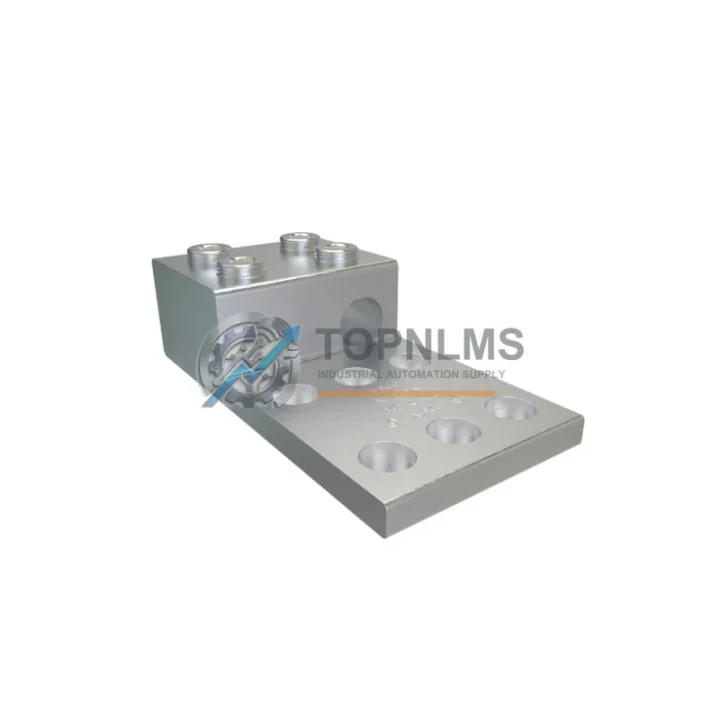
In industrial environments where electrical continuity is non-negotiable, the Reflexite AU350 compression terminal lug stands as a critical component in maintaining the integrity of high-current conductor terminations. Designed for the AU Series platform, the AU350 delivers reliable, gas-tight connections that resist vibration, thermal cycling, and the corrosive atmospheres common in manufacturing plants, process facilities, and power distribution switchgear. Whether you are managing a scheduled shutdown, responding to an unplanned fault, or building a strategic spare-parts inventory, the AU350 is a component that belongs on your procurement list before the need becomes urgent.
Sourced directly from Reflexite’s original production line and manufactured in Germany to DIN and IEC standards, the AU350 maintains dimensional and electrical compatibility with the full AU Series conductor termination system. Its heavy-duty barrel geometry accommodates 350 mm² cross-section conductors, providing low-resistance, mechanically stable joints that meet the demands of motor control centers, main distribution boards, transformer secondary connections, and large-scale PLC/DCS power supply cabinets.
Critical Technical Specs
| Parameter |
Specification |
| Part Number / SKU |
AU350 |
| Brand |
Reflexite |
| Series |
AU Series |
| Product Type |
Compression Terminal Lug |
| Conductor Cross-Section |
350 mm² |
| Connection Method |
Hydraulic / Mechanical Compression |
| Material |
Electrolytic Copper, Tin-Plated |
| Voltage Rating |
Up to 1 kV (low-voltage distribution) |
| Current Carrying Capacity |
Rated for 350 mm² conductor load |
| Compliance Standards |
DIN 46235, IEC 61238-1 |
| Country of Origin |
Germany |
| Installation Method |
Compression crimping tool (hex or indent die) |
| Application Environment |
Indoor/outdoor switchgear, MCC, power distribution panels, PLC/DCS power cabinets |
| Maintenance Recommendation |
Inspect torque and surface oxidation every 12–24 months; replace if barrel deformation or discoloration is observed |
| Weight |
323 g |
| Warranty |
12 Months |
Preventive Maintenance Strategy
A compression terminal lug failure rarely occurs in isolation. In most industrial facilities, the AU350 is installed at the termination points of main feeder cables feeding motor control centers, variable frequency drives, or large PLC/DCS power supply modules. When a maintenance team opens a control cabinet for inspection or fault diagnosis, the AU350 connection point is one of the first areas to assess — checking for discoloration, micro-arcing residue, or mechanical loosening caused by thermal expansion cycles.
During the same inspection window, experienced maintenance engineers will simultaneously verify the condition of adjacent components. The copper busbars and busbar support insulators that distribute current from the AU350 termination point downstream should be checked for cracking or tracking marks. The main circuit breaker or molded-case circuit breaker (MCCB) protecting the feeder circuit should be exercised and its contact resistance measured. If the cabinet houses a Siemens SIMATIC S7 or similar PLC rack, the 24 VDC power supply module (such as a SITOP PSU series unit) feeding the CPU and I/O modules should be load-tested, as power supply degradation often manifests as intermittent CPU faults rather than hard failures.
For facilities running Schneider Electric Modicon or ABB AC500 PLC systems, the same logic applies: while the AU350 lug is being replaced or re-crimped on the incoming power feed, it is operationally efficient to inspect the DIN rail terminal blocks (such as Phoenix Contact PTFIX or Weidmüller WDU series) distributing 24 VDC to field devices. Loose or oxidized terminal connections at this level are a leading cause of intermittent sensor faults and spurious I/O alarms. Replacing a batch of worn terminal blocks during the same maintenance window eliminates a second unplanned shutdown.
Signal integrity in the same cabinet should also be reviewed. Analog signal isolators (4–20 mA loop isolators) and relay output modules connected to the same power rail as the AU350 termination are susceptible to voltage transients during a lug replacement if proper lockout/tagout procedures are not followed. Keeping spare relay modules (such as Phoenix Contact PLC-RSC or Omron G2R series) and signal isolators on the shelf ensures that any collateral damage discovered during the AU350 replacement can be addressed immediately without extending the maintenance window.
For high-current applications where the AU350 feeds transformer secondary connections or generator output panels, it is advisable to stock complementary components: heat-shrink insulation sleeves rated for the conductor diameter, compression die sets matched to the AU350 barrel geometry, and a calibrated torque wrench or hydraulic crimping tool. Fuse holders and NH fuse links (gG or aM characteristic) protecting the downstream circuit should be inspected for contact pressure and replaced on a scheduled basis rather than reactively. Finally, the cable gland or conduit entry sealing the 350 mm² feeder cable into the enclosure should be checked for ingress protection integrity — a degraded IP seal is a common but overlooked root cause of terminal corrosion that accelerates AU350 lug failure.
Strategic Replacement Solutions
The Reflexite AU350 is engineered as a direct replacement for legacy heavy-duty compression lugs used in older switchgear and distribution panels that may have originally been fitted with now-discontinued part numbers from the same AU Series lineage. Facilities operating equipment installed in the 1990s or early 2000s frequently encounter situations where the original lug specification is no longer available through the OEM’s current catalog. The AU350’s compliance with DIN 46235 and IEC 61238-1 ensures dimensional interchangeability with any lug manufactured to the same standard, regardless of the original supplier.
From a downtime-reduction perspective, having the AU350 in stock before a failure occurs is the single most effective strategy. A 350 mm² feeder cable termination failure in a main distribution board can take an entire production line or facility offline within seconds. The lead time for sourcing a non-stocked heavy-duty lug through conventional supply chains can range from several days to several weeks, depending on regional availability. Maintaining a minimum stock of two to four AU350 units per critical termination point — particularly in facilities with aging infrastructure or high thermal cycling loads — is a widely adopted best practice in industrial maintenance planning.
The AU350 also supports system modernization without full panel replacement. When upgrading a legacy distribution board to accommodate new variable frequency drives or soft starters with higher inrush current profiles, the AU350 provides the conductor termination capacity needed to handle the upgraded load without requiring a complete busbar redesign. This makes it a cost-effective bridge component in phased modernization projects where capital expenditure must be minimized while operational reliability is maintained.
All AU350 units supplied by TOPNLMS are tested prior to dispatch, including dimensional verification, surface finish inspection, and continuity checks. Each unit ships with documentation supporting traceability to the original manufacturing batch. A 12-month warranty covers material and workmanship defects under normal operating conditions.
Support FAQ
Q1: What is the expected service life of the Reflexite AU350 in a high-cycle industrial environment?
Under normal operating conditions — stable load current, ambient temperature within rated range, and correct crimping tool application — the AU350 is designed for the service life of the installation, typically 20–30 years. In high thermal cycling environments (frequent motor starts, generator switching), annual inspection of crimp integrity and surface oxidation is recommended. Replace immediately if barrel deformation, discoloration, or elevated contact resistance is detected during thermographic inspection.
Q2: How do I verify compatibility with my existing AU Series installation before ordering?
Confirm the conductor cross-section (350 mm²), the stud bolt diameter and pitch of your existing lug mounting point, and the palm dimensions required by your busbar or equipment terminal. The AU350 conforms to DIN 46235 geometry — cross-reference your existing lug’s dimensional drawing against this standard. If you have the original panel documentation or a sample lug available, our technical team can assist with compatibility verification prior to shipment.
Q3: What pre-shipment testing is performed on each AU350 unit?
Each AU350 undergoes dimensional inspection (barrel bore, palm hole diameter, overall length), surface finish verification (tin-plating continuity and adhesion), and visual inspection for casting or drawing defects. Units are individually packaged to prevent transit damage. A batch test certificate is available upon request for quality-critical installations.
Q4: What does the 12-month warranty cover, and how is a warranty claim processed?
The 12-month warranty covers manufacturing defects in materials and workmanship under normal installation and operating conditions. It does not cover damage resulting from incorrect crimping tool selection, over-torquing, installation in environments exceeding the rated voltage or temperature range, or physical damage in transit after delivery. To initiate a warranty claim, contact [email protected] with your order reference, a description of the defect, and photographic evidence. Replacement units are dispatched upon claim verification.