Product Overview
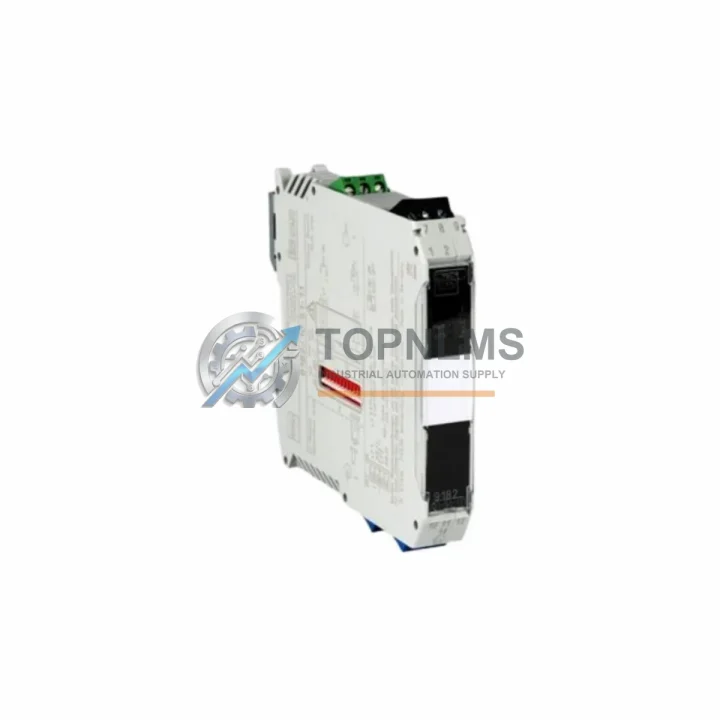
R. STAHL 9182/20-51-11 Original Industrial Spare Series 9182 Compatible: Ensuring System Stability in Hazardous-Area Process Control
In process industries where continuous uptime is non-negotiable — refineries, chemical plants, offshore platforms, and pharmaceutical production lines — the R. STAHL 9182/20-51-11 Ex ia temperature transmitter stands as a critical link between field instrumentation and the control room. Designed for intrinsically safe operation in Zone 0/1/2 hazardous areas, this Series 9182 unit converts thermocouple or RTD signals into a standardized 4–20 mA output, delivering accurate temperature data to your DCS or PLC under the most demanding conditions. Sourced as an original spare from authorized supply channels, the 9182/20-51-11 is tested, serialized, and shipped with a 12-month warranty — ready to restore your loop integrity the moment it arrives on site.
Critical Technical Specs
| Part Number |
9182/20-51-11 |
| Brand / Manufacturer |
R. STAHL (Germany) |
| Series |
9182 |
| Product Type |
Intrinsically Safe Temperature Transmitter (Head-Mount) |
| Protection Concept |
Ex ia IIC T4/T5/T6 (Intrinsic Safety) |
| Certifications |
ATEX, IECEx |
| Hazardous Area Classification |
Zone 0, Zone 1, Zone 2 (Gas); Zone 20, 21, 22 (Dust) |
| Input Sensor Types |
Thermocouple (Type J, K, T, E, R, S, B, N) / RTD (Pt100, Pt1000, Ni100) |
| Output Signal |
4–20 mA (2-wire HART) |
| Supply Voltage |
11.5–30 V DC (intrinsically safe barrier supply) |
| Ambient Temperature Range |
–40 °C to +85 °C |
| Enclosure / Mounting |
DIN B head-mount (Form B terminal head) |
| Country of Origin |
Germany |
| Compatibility |
Compatible with Zener barriers (e.g., R. STAHL Series 9001/9002), galvanic isolators, and standard DCS/PLC analog input cards accepting 4–20 mA HART signals |
| Typical Applications |
Reactor temperature monitoring, pipeline process control, storage tank instrumentation, compressor skid control |
| Maintenance Recommendation |
Inspect and recalibrate every 12–24 months; replace sensor input wiring and terminal blocks during scheduled turnarounds |
| Warranty |
12 Months — covers manufacturing defects; each unit tested prior to dispatch |
Preventive Maintenance Strategy: Protecting Your Hazardous-Area Temperature Loop
A temperature transmitter failure in a hazardous-area loop rarely occurs in isolation. When a 9182/20-51-11 unit is flagged for replacement during a planned turnaround or emergency shutdown, experienced maintenance engineers treat it as a trigger for a broader loop inspection. The intrinsic safety circuit depends on the integrity of every component in the barrier-to-field chain — and a systematic check at replacement time dramatically reduces the probability of repeat failures.
Begin at the Zener barrier or galvanic isolator panel. R. STAHL Series 9001 Zener barriers and Series 9002 galvanic isolators are the most common associated apparatus paired with the 9182 transmitter in legacy installations. Verify that the barrier’s fuse is intact, that the entity parameters (Ui, Ii, Pi) remain within the transmitter’s rated input parameters, and that the barrier’s earth connection meets IEC 60079-14 requirements. A degraded barrier is frequently the root cause of transmitter drift or premature failure — stocking a spare barrier alongside the 9182/20-51-11 is a sound inventory decision.
Next, inspect the field wiring and cable glands. In Ex ia loops, cable capacitance and inductance must remain within certified limits. Check for insulation degradation, moisture ingress at the terminal head, and corrosion on the Pt100 or thermocouple extension cable terminals. Replace the terminal head gasket and cable gland (R. STAHL Series 8161 or equivalent) if any sign of moisture is present — a compromised seal in a Zone 1 area is a safety and reliability risk that no maintenance budget can afford to ignore.
At the DCS or PLC analog input card, confirm that the channel receiving the 4–20 mA HART signal is functioning correctly. Cards such as the Siemens SIMATIC S7 SM 331 analog input module or equivalent Yokogawa/Honeywell DCS AI cards should be loop-tested with a calibrator before the new transmitter is commissioned. A faulty AI channel will cause the replacement transmitter to appear defective — a common and costly diagnostic error in the field.
While the control cabinet is open, inspect the 24 V DC power supply rail feeding the barrier panel. Redundant power supplies — such as the R. STAHL Series 9210 or equivalent SITOP PSU100S — should be load-tested and their output voltage verified under full loop load. A sagging supply voltage is a silent killer of HART communication integrity and transmitter accuracy.
For installations using HART multiplexers or asset management systems (e.g., Emerson AMS, Yokogawa PRM), reconnect the HART handheld communicator after installation to verify device identity, perform a sensor trim, and confirm that the primary variable reads correctly against a reference thermometer. Document the as-found and as-left calibration data in your CMMS — this record is essential for both regulatory compliance and future maintenance planning.
Finally, review your spare parts inventory plan for the broader Series 9182 family. If your facility operates multiple temperature loops in hazardous areas, consider stocking the 9182/20-51-01 (thermocouple-only variant) and 9182/20-51-21 (extended range variant) alongside the 9182/20-51-11 to cover the full range of sensor configurations on site. Pairing these with a stock of Pt100 RTD sensors, thermocouple extension cables, M20 cable glands, and DIN rail terminal blocks ensures that your maintenance team can complete a full loop restoration without waiting for additional procurement cycles — minimizing mean time to repair (MTTR) and protecting production continuity.
Strategic Replacement Solutions: Extending Legacy System Life
Many process plants operating R. STAHL Series 9182 transmitters are running control architectures that are 15–25 years old. The decision to replace a failed 9182/20-51-11 with an original spare — rather than migrating to a newer transmitter platform — is often the most cost-effective and operationally prudent choice. Original spare replacement preserves the existing ATEX/IECEx loop certification, eliminates the need for re-engineering the associated apparatus selection, and avoids the configuration changes that a new transmitter model would require in the DCS asset management database.
For plants where the 9182/20-51-11 has been discontinued from local distributor stock, sourcing from a specialist industrial spare parts supplier with verified original inventory is critical. Counterfeit or non-original transmitters in Ex ia loops present both a safety hazard and a certification compliance risk. Each unit supplied by TOPNLMS is sourced from authorized channels, individually tested for output accuracy and HART communication, and shipped with full traceability documentation — supporting your site’s IEC 60079-17 inspection records and insurance requirements.
Where a direct like-for-like replacement is required urgently — for example, during an unplanned shutdown — the 9182/20-51-11’s standard DIN B head-mount form factor means installation is a drop-in procedure requiring no mechanical modification. Commissioning time is typically under 30 minutes for a trained instrument technician, making it one of the fastest loop restoration options available for hazardous-area temperature measurement.
Support FAQ
Q1: Is the 9182/20-51-11 still in production, and how do I verify authenticity?
The Series 9182 has been a long-running R. STAHL product line. Units supplied by TOPNLMS are sourced from authorized distribution channels and carry original R. STAHL labeling, serial numbers, and calibration documentation. We recommend verifying the serial number with R. STAHL’s product traceability service upon receipt.
Q2: What is the warranty coverage and what does pre-shipment testing include?
Every 9182/20-51-11 unit is tested for 4–20 mA output linearity, HART communication, and sensor input response before dispatch. The 12-month warranty covers manufacturing defects and functional failures under normal operating conditions. Warranty claims are processed with full RMA support.
Q3: Can this transmitter replace older 9182 variants with different suffix codes?
Compatibility depends on the sensor input configuration and output range encoded in the suffix. The -51-11 suffix denotes a specific input/output combination. Before substituting a different suffix variant, verify the entity parameters and sensor type against your loop documentation. Our technical team can assist with compatibility verification prior to purchase.
Q4: What is the recommended spare parts holding strategy for multi-loop hazardous-area installations?
For facilities with 10 or more Ex ia temperature loops, we recommend holding a minimum of 2–3 units of the 9182/20-51-11 as on-site critical spares, supplemented by at least one spare Zener barrier per barrier type in use. For larger installations (50+ loops), a tiered inventory strategy — combining on-site fast-movers with a supplier-held buffer stock agreement — provides the best balance of capital efficiency and availability assurance.