

ProSoft Technology
ProSoft MVI56-DFCM Replacement/Upgrade for ControlLogix
MVI56-DFCMMVI56-DFCM drop-in replacement for ControlLogix. DF1 full-duplex compatibility, 12-month warranty, fast global shipping from TOPNLMS.
Request availability, condition, lead time and export shipping details for MVI56E-MNETCR.
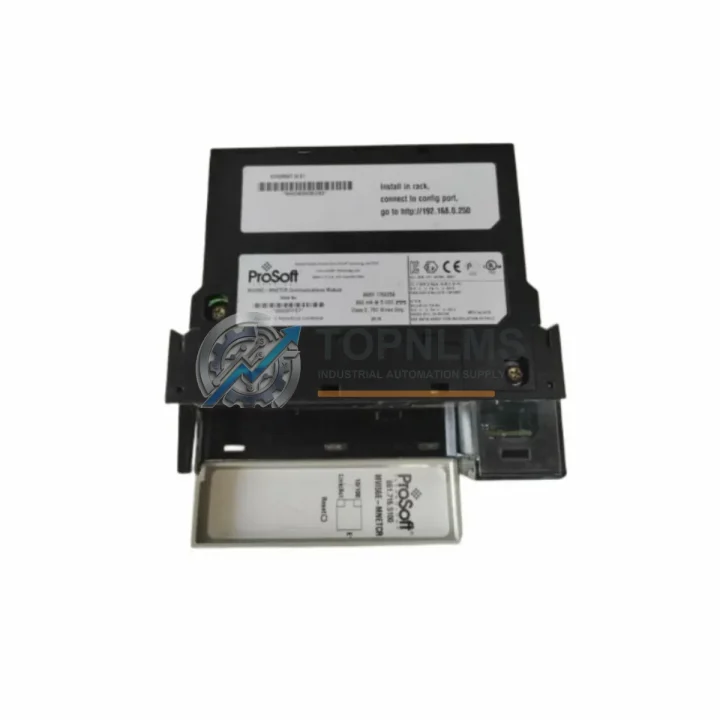
Send this exact part number, quantity and destination country. TOPNLMS will confirm availability, condition and export lead time before quotation.
The ProSoft MVI56E-MNETCR is a high-performance Modbus TCP/IP Client/Server communication module engineered for Allen-Bradley ControlLogix and GuardLogix backplane platforms. As legacy MVI56-MNET and first-generation MVI56E-series modules approach end-of-life or become increasingly difficult to source, the MVI56E-MNETCR provides a direct, drop-in upgrade path that preserves existing wiring infrastructure, ladder logic structure, and system architecture — dramatically reducing retrofit engineering time and unplanned downtime.
This module supports up to 100 Modbus TCP/IP Client and Server connections simultaneously, enabling seamless integration with field devices such as variable frequency drives, remote I/O adapters, energy meters, and third-party SCADA systems — all without modifying the existing Ethernet network topology. The MVI56E-MNETCR mounts directly into any standard 1756 ControlLogix chassis slot, making it physically interchangeable with earlier MVI56-MNET variants and compatible with existing 1756-A4, 1756-A7, 1756-A10, and 1756-A13 chassis configurations.
For facilities migrating from legacy DCS platforms or older Modbus RTU serial architectures, the MVI56E-MNETCR eliminates the need for external protocol converters or signal isolators by natively bridging Modbus TCP/IP to the ControlLogix backplane via the standard 1756 backplane interface. Engineers replacing discontinued modules such as the MVI56-MNET or MVI56E-MNET will find that existing Add-On Instructions (AOIs) and ProSoft Configuration Builder (PCB) project files can be reused with minimal modification, preserving years of control logic investment.
During system commissioning, the module’s integrated web server and ProSoft Configuration Builder software allow technicians to configure connection parameters, map Modbus register blocks to ControlLogix controller tags, and monitor live data traffic — all without interrupting the running PLC program. This is particularly valuable in continuous-process environments such as water treatment, oil and gas, and power distribution, where planned maintenance windows are limited.
When upgrading a ControlLogix rack that previously relied on a 1756-ENBT or 1756-EN2T Ethernet bridge for Modbus polling, the MVI56E-MNETCR consolidates communication tasks directly into the backplane, freeing Ethernet bridge capacity for HMI and historian traffic. Facilities using FactoryTalk View SE or FactoryTalk Historian will benefit from reduced network congestion and improved scan-cycle determinism.
Power requirements are supplied entirely through the 1756 backplane, eliminating the need for external 24 VDC field power wiring to the module itself. This simplifies control cabinet layout and reduces the risk of field wiring errors during replacement. The module’s compact single-slot form factor ensures compatibility with high-density rack configurations where space is at a premium.
For multi-rack or remote I/O architectures using 1756-DHRIO or 1756-CN2 communication modules, the MVI56E-MNETCR integrates without conflict, allowing mixed-protocol environments to coexist within the same ControlLogix chassis. Sites running hybrid architectures — combining legacy DeviceNet, ControlNet, and Ethernet/IP segments — can add Modbus TCP/IP capability without redesigning the existing network hierarchy.
Procurement teams will find that TOPNLMS maintains verified stock of the MVI56E-MNETCR with full factory testing, serialized inspection records, and a 12-month replacement warranty. Each unit ships with original ProSoft documentation, configuration software access, and a pre-shipment functional test report. Standard lead time from our Xiamen warehouse is 3–7 business days for international destinations, with expedited options available for critical plant shutdowns.
| Parameter | Legacy: MVI56-MNET | Replacement: MVI56E-MNETCR |
|---|---|---|
| Platform | ControlLogix 1756 | ControlLogix / GuardLogix 1756 |
| Backplane Interface | 1756 Standard Backplane | 1756 Standard Backplane (direct fit) |
| Protocol | Modbus TCP/IP (Client only) | Modbus TCP/IP Client + Server (100 connections) |
| Ethernet Port | 10/100 Mbps, RJ45 | 10/100 Mbps, RJ45 (same pinout) |
| Slot Requirement | 1 slot | 1 slot (drop-in compatible) |
| Power Supply | Backplane powered | Backplane powered (no field wiring change) |
| Configuration Tool | ProSoft Configuration Builder | ProSoft Configuration Builder (project reuse) |
| Firmware Upgrade | Not supported (EOL) | Supported via web interface |
| Chassis Compatibility | 1756-A4/A7/A10/A13 | 1756-A4/A7/A10/A13 (identical) |
| Replacement Recommendation | — | Direct replacement; reuse existing AOIs |
| Warranty | Expired / EOL | 12-Month Replacement Warranty |
A complete MVI56E-MNETCR migration typically involves coordinating several interdependent components within the same ControlLogix rack or control cabinet. The 1756-L73 or 1756-L83E ControlLogix controller serves as the host processor and must be confirmed compatible with the firmware revision of the replacement module. In racks where power budget is a concern, the 1756-PA75 or 1756-PB75 power supply should be verified against the updated slot load calculation after module substitution.
For sites that previously used a 1756-ENBT Ethernet bridge to route Modbus polling traffic, the MVI56E-MNETCR’s onboard Ethernet port can assume that role directly, allowing the ENBT slot to be repurposed or removed. Where remote I/O expansion is required, 1734 POINT I/O adapters connected via EtherNet/IP remain fully compatible alongside the MVI56E-MNETCR on the same network segment.
Facilities upgrading from serial Modbus RTU environments may also require a ProSoft MVI56E-MNET or MVI56E-MCM serial communication module to bridge legacy RTU field devices during the transition period, allowing phased migration without a full cutover. Programming and configuration changes are managed through Studio 5000 Logix Designer, where existing tag structures and AOI blocks can be imported directly from the legacy project file.
For HMI integration, PanelView Plus 7 terminals communicating via EtherNet/IP to the ControlLogix controller require no reconfiguration when the MVI56E-MNETCR is substituted, as the module operates transparently within the backplane tag space. Signal conditioning between field transmitters and the Modbus network may be handled by Phoenix Contact or Weidmuller signal isolators already installed in the marshalling cabinet, which remain fully compatible with the TCP/IP polling architecture of the MVI56E-MNETCR.
Q: Can I reuse my existing Ethernet cable and RJ45 patch panel connections?
Yes. The MVI56E-MNETCR uses a standard RJ45 10/100 Mbps interface with the same pinout as the legacy MVI56-MNET. No rewiring is required at the patch panel or field junction box level.
Q: Do I need to rewrite my ControlLogix ladder logic or AOIs?
In most cases, no. The MVI56E-MNETCR uses the same ProSoft Configuration Builder project structure and compatible controller tag mapping. Existing AOIs can typically be reused after updating the module definition in the I/O tree within Studio 5000.
Q: Is the Modbus register map preserved during replacement?
Yes. The MVI56E-MNETCR supports the same Modbus function codes (FC01–FC06, FC15, FC16) and register address ranges as the legacy module. Existing SCADA or DCS polling configurations do not require modification.
Q: What happens to my physical installation space in the rack?
The MVI56E-MNETCR occupies a single 1756 backplane slot — identical to the legacy MVI56-MNET. No additional slots, brackets, or mounting hardware are required.
Q: Can this module coexist with ControlNet or DeviceNet modules in the same chassis?
Yes. The MVI56E-MNETCR operates independently on the backplane and does not interfere with 1756-CN2 ControlNet or 1756-DNB DeviceNet bridge modules installed in adjacent slots.
Q: What is the recommended procedure for a live system cutover?
Power down the rack or use a hot-swap chassis if available. Remove the legacy module, insert the MVI56E-MNETCR, restore power, and download the updated Studio 5000 project. The module’s web server can be used to verify Modbus connection status before returning the system to automatic mode.
Every MVI56E-MNETCR unit supplied by TOPNLMS is covered by a 12-month replacement warranty from the date of shipment. Prior to dispatch, each module undergoes a multi-point functional test including backplane communication verification, Ethernet port integrity check, and Modbus TCP/IP loopback testing. A serialized test report is included with each shipment.
In the event of a confirmed hardware fault within the warranty period, TOPNLMS will arrange priority replacement shipment at no additional cost. Our technical support team is available to assist with configuration questions, compatibility verification, and commissioning guidance via email and phone. We maintain buffer stock of MVI56E-MNETCR units specifically to support emergency plant shutdown scenarios with same-day dispatch capability from our Xiamen warehouse.
For volume procurement, blanket purchase orders, and project-based supply agreements, please contact our industrial sales team directly. All units are sourced through verified distribution channels with full traceability documentation available upon request.
MVI56-DFCM drop-in replacement for ControlLogix. DF1 full-duplex compatibility, 12-month warranty, fast global shipping from TOPNLMS.
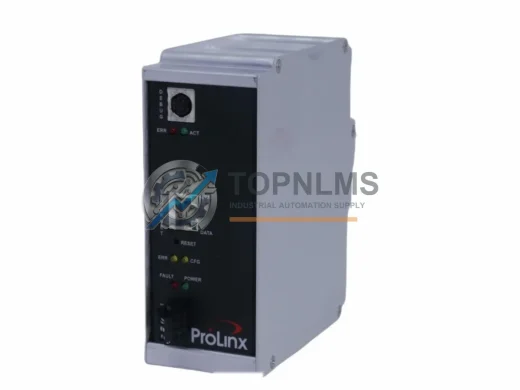
ProSoft 5201-DFNT-EGD EtherNet/IP to GE EGD in-chassis gateway. Rugged, reliable, 12-month warranty. In stock at TOPNLMS — fast global shipping.

ProSoft MVI56-101M Modbus RTU/ASCII module for ControlLogix. Ruggedized, in stock, tested, 12-month warranty. Fast shipping — TOPNLMS.

ProSoft PLX31-MBTCP-MBS Modbus TCP/IP to Serial gateway. Rugged, EMI-resistant, 12-month warranty. In stock — fast shipping from TOPNLMS.
Click Quote This Model and the Part Number field will auto-fill with MVI56E-MNETCR.