
EPRO
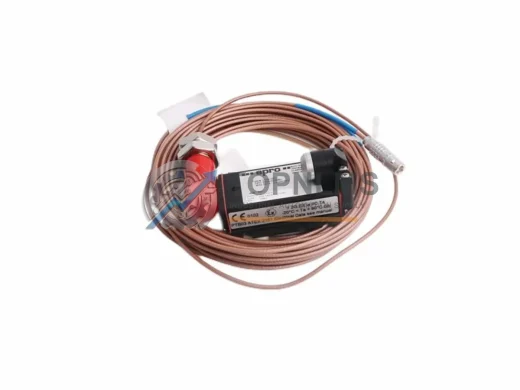
EPRO PR6424/010-040 CON021 Ruggedized Proximity Sensor
PR6424/010-040 CON021EPRO PR6424/010-040 CON021 eddy current proximity sensor. Certified for harsh industrial environments. In stock, tested, 12-month warranty. Fast global shipping.
Request availability, condition, lead time and export shipping details for PR6423/003-110 CON021.
Send this exact part number, quantity and destination country. TOPNLMS will confirm availability, condition and export lead time before quotation.
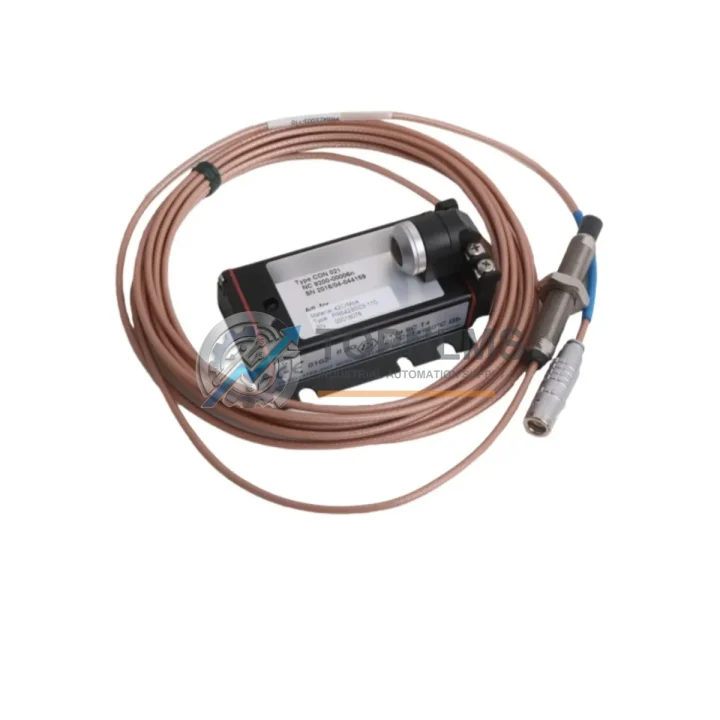
The EPRO PR6423/003-110 CON021 is an original eddy current vibration transducer module engineered for continuous shaft displacement and vibration monitoring in rotating machinery. As a core component of the EPRO PR6423 Series, this transducer is widely deployed in turbines, compressors, pumps, and generators across power generation, petrochemical, and heavy manufacturing facilities. When this module fails or degrades, the consequences extend beyond a single sensor — the entire vibration monitoring loop is compromised, leaving critical rotating equipment unprotected and exposing the plant to unplanned shutdown risk.
Sourcing a verified original PR6423/003-110 CON021 replacement is the fastest path to restoring full system integrity. TOPNLMS stocks this module with full traceability, pre-shipment electrical verification, and a 12-month warranty, ensuring your maintenance team can execute a confident, same-day swap without extended lead times or compatibility uncertainty.
| Parameter | Specification |
|---|---|
| Part Number | PR6423/003-110 CON021 |
| Series | EPRO PR6423 |
| Sensor Type | Eddy Current (Non-contact) Vibration Transducer |
| Measurement | Shaft radial vibration & displacement |
| Cable Length | 3 m (extension cable, CON021 configuration) |
| Output Signal | –24 VDC bias, standard EPRO signal chain compatible |
| Operating Temperature | –40°C to +120°C (probe tip); –40°C to +85°C (cable) |
| Ingress Protection | IP67 (probe assembly) |
| Compatibility | EPRO CON021 driver/conditioner; PR6423 Series probes; Bently Nevada 3300 XL signal-compatible systems |
| Mounting | M10 × 1 threaded probe tip; bracket or direct-mount |
| Country of Origin | Germany |
| Weight | 320 g (assembled) |
| Warranty | 12 Months — covers electrical performance and mechanical integrity |
Vibration transducer replacement rarely occurs in isolation. In practice, a maintenance shutdown triggered by a degraded PR6423/003-110 CON021 is the ideal opportunity to audit the entire vibration monitoring chain and adjacent control infrastructure. Experienced maintenance engineers know that a single failed sensor often signals broader wear across the loop.
Begin with the CON021 signal conditioner/driver module — the transducer and conditioner form a matched pair, and a worn conditioner will produce erratic output even with a new probe installed. Inspect the PR6423 extension cable for insulation cracking, connector corrosion, or mechanical damage at the cable gland entry points; cable degradation is a leading cause of intermittent vibration alarms that are frequently misdiagnosed as probe failure.
While the control cabinet is open, verify the health of the EPRO MMS 6350 or MMS 6110 vibration monitoring card that processes the transducer signal. These cards accumulate thermal stress over years of continuous operation and should be inspected for capacitor bulge, relay contact wear, and firmware currency. If your plant runs a Bently Nevada 3500 Series rack alongside EPRO hardware, cross-check the 3500/42M position monitor module and its associated I/O terminal blocks for loose terminations — vibration data integrity depends on clean signal paths end-to-end.
For facilities operating steam turbines or large centrifugal compressors, the PR6423 transducer works in conjunction with keyphasor probes (such as the EPRO PR9268 Series) to provide phase-referenced vibration analysis. Inspect keyphasor probe gap settings and cable routing during the same outage window. Additionally, review the power supply module feeding the vibration monitoring rack — an unstable –24 VDC supply is a common root cause of false vibration trips and should be load-tested before returning the system to service.
At the PLC or DCS integration layer, confirm that the analog input module receiving the 4–20 mA or voltage output from the vibration monitor is functioning within calibration tolerance. Modules such as the Siemens SM 331 or equivalent analog input cards should be verified for channel drift, especially on channels that have been in continuous service for more than five years. Finally, inspect the terminal blocks and DIN rail assemblies within the vibration monitoring cabinet — loose terminations at Phoenix Contact or Weidmüller terminal strips are a frequent source of signal noise that can mask genuine machinery faults.
The PR6423/003-110 CON021 is a direct original replacement for aging PR6423 Series probes installed during original equipment commissioning. Many plants commissioned in the 1990s and 2000s are still running first-generation EPRO transducers that have exceeded their recommended service life of 8–10 years. Replacing with an original EPRO module — rather than an uncertified aftermarket alternative — preserves the factory-calibrated sensitivity constant (typically 8 mV/µm), eliminates recalibration overhead, and maintains full compatibility with existing CON021 conditioners and downstream monitoring racks without any signal chain reconfiguration.
For plants managing a fleet of rotating machines, a strategic approach is to maintain a minimum of two PR6423/003-110 CON021 units in bonded spare inventory. This eliminates the critical path dependency on international shipping lead times during an unplanned outage — a single compressor trip can cost tens of thousands of dollars per hour in lost production, making the cost of a spare transducer negligible by comparison. TOPNLMS supports bulk spare procurement with consistent lot traceability, enabling your reliability team to implement a structured first-in, first-out rotation policy.
For legacy systems where the original CON021 conditioner is no longer available, the PR6423/003-110 can also be evaluated for compatibility with third-party signal conditioners that accept standard eddy current probe inputs — however, sensitivity constant verification and gap calibration must be performed by a qualified instrumentation technician before returning the loop to protective service.
Q1: Is the PR6423/003-110 CON021 an original EPRO component or a compatible replacement?
The unit supplied by TOPNLMS is an original EPRO PR6423/003-110 CON021 module, not an aftermarket copy. Each unit undergoes pre-shipment electrical verification including bias voltage check, sensitivity constant confirmation, and insulation resistance testing before dispatch.
Q2: What does the 12-month warranty cover?
The 12-month warranty covers electrical performance (output signal integrity, sensitivity constant within ±5% of specification) and mechanical integrity (connector housing, cable jacket, probe tip). Warranty claims are supported with a replacement-first policy — we ship a verified replacement unit before requiring return of the defective module, minimizing your downtime exposure.
Q3: How do I verify compatibility with my existing CON021 conditioner and monitoring rack?
The PR6423/003-110 CON021 is designed as a matched system with the EPRO CON021 signal conditioner. Compatibility is confirmed by verifying the conditioner’s input impedance specification and the probe’s nominal gap range (typically 0.25–2.25 mm for standard PR6423 probes). If you are integrating into a Bently Nevada 3500 rack, confirm the monitor card’s input configuration matches the EPRO sensitivity constant of 8 mV/µm. Our technical team can assist with compatibility verification prior to order.
Q4: What is the recommended spare inventory strategy for PR6423 Series transducers?
For facilities with 10 or more PR6423 Series probes in service, reliability best practice recommends maintaining a minimum 10–15% spare ratio (i.e., one spare per 7–10 installed probes), with spares stored in a temperature-controlled environment away from strong magnetic fields. Probes should be rotated into service on a scheduled basis (every 5–7 years) rather than run-to-failure, as eddy current probe sensitivity can drift gradually before producing a detectable alarm condition.
EPRO PR6424/010-040 CON021 eddy current proximity sensor. Certified for harsh industrial environments. In stock, tested, 12-month warranty. Fast global shipping.
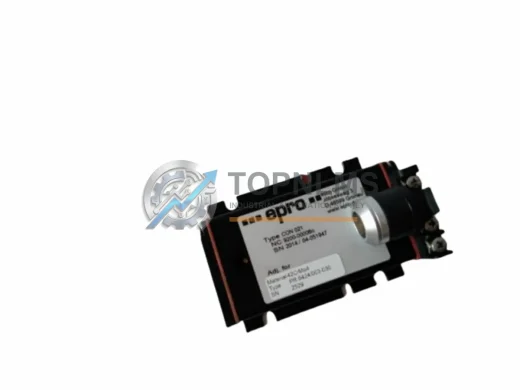
EPRO PR6424/000-030-CN CON021 dual-channel eddy current vibration monitor. Drop-in MMS 6000 replacement & upgrade. 12-month warranty. Ships from Xiamen.
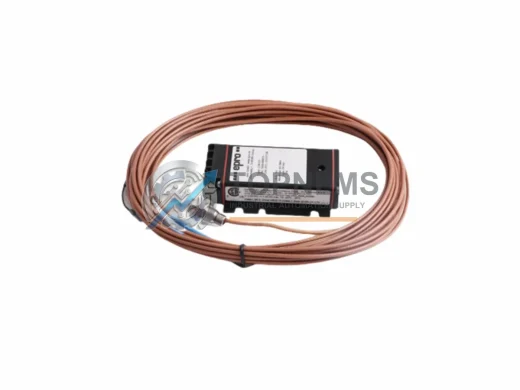
EPRO PR6423/015-000-CN CON021 ruggedized eddy current proximity sensor. MMS 6000 series. In stock, tested, 12-month warranty. Fast global shipping from TOPNLMS.
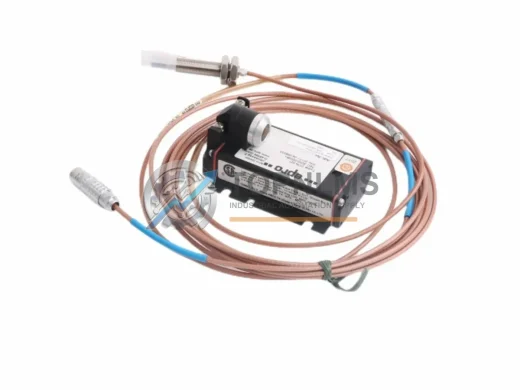
EPRO PR6423/014-040 CON021 eddy current proximity sensor for harsh industrial environments. 12-month warranty, tested stock, fast shipping. Buy at TOPNLMS.
Click Quote This Model and the Part Number field will auto-fill with PR6423/003-110 CON021.