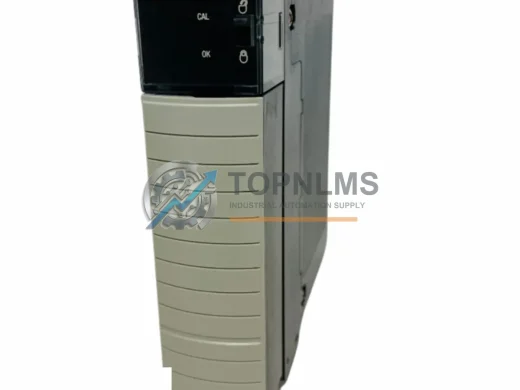
Product Overview
Allen-Bradley 1794-IRTB Original Industrial Spare FLEX I/O Compatible: Ensuring System Stability in Demanding Industrial Environments
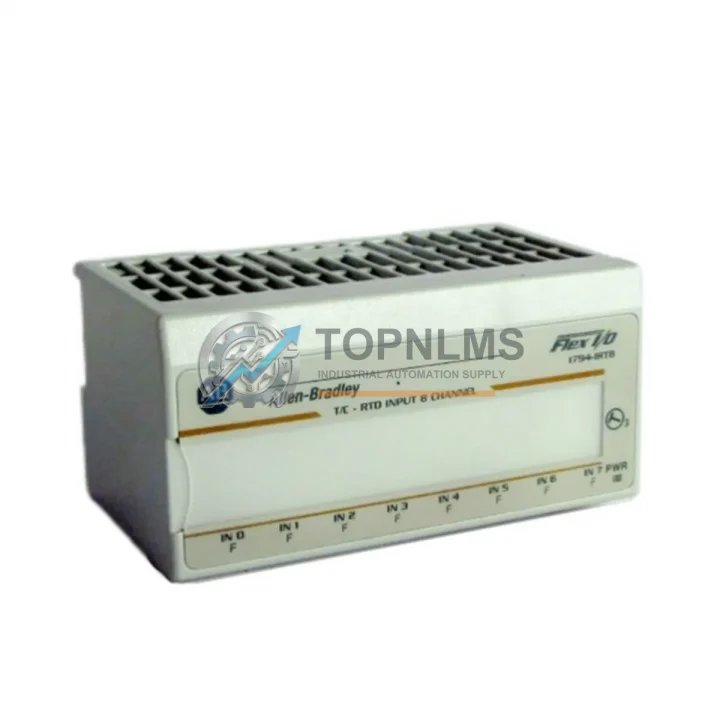
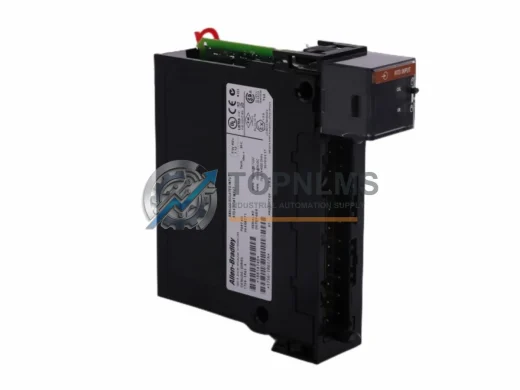
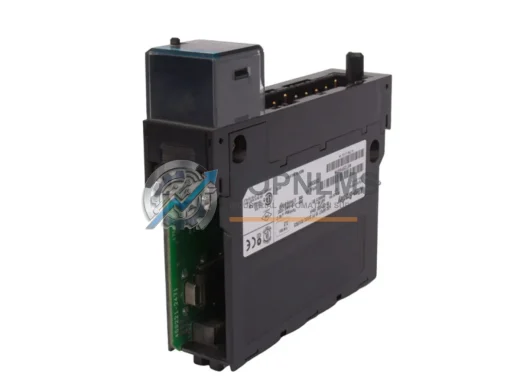
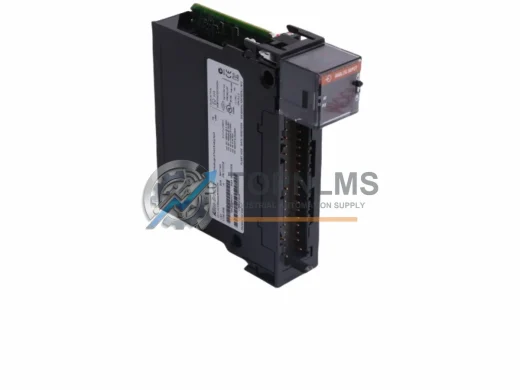
The Allen-Bradley 1794-IRTB is an 8-channel RTD and resistance input module designed for the Rockwell Automation FLEX I/O platform. As a critical measurement and signal acquisition component within distributed control architectures, the 1794-IRTB plays an indispensable role in maintaining accurate temperature monitoring, process feedback loops, and system-wide stability across manufacturing, petrochemical, food processing, water treatment, and heavy industrial facilities.
In modern industrial environments where unplanned downtime translates directly into production losses and safety risks, maintaining a verified stock of original spare parts is not optional — it is a core operational discipline. The 1794-IRTB, as an original Allen-Bradley FLEX I/O module, provides the precise signal conditioning and channel isolation required for reliable RTD-based temperature measurement without the compatibility risks associated with third-party substitutes. Each unit shipped from TOPNLMS undergoes pre-shipment functional verification and is backed by a 12-month warranty, giving maintenance engineers and procurement teams the confidence to plan replacements proactively rather than reactively.
Critical Technical Specs
| Parameter |
Specification |
| Part Number |
1794-IRTB |
| Brand / Manufacturer |
Allen-Bradley / Rockwell Automation |
| Series |
FLEX I/O (1794 Series) |
| Module Type |
8-Channel RTD & Resistance Input Module |
| Input Channels |
8 differential RTD / resistance inputs |
| RTD Types Supported |
Pt100, Pt200, Pt500, Pt1000, Ni100, Ni120, Cu10 (typical FLEX I/O RTD range) |
| Resistance Range |
0–3000 Ω (nominal) |
| Resolution |
16-bit analog-to-digital conversion |
| Backplane Communication |
FLEX I/O backplane via 1794 adapter (e.g., 1794-AENT, 1794-ADN, 1794-ACN15) |
| Power Consumption |
Supplied via FLEX I/O backplane |
| Operating Temperature |
0°C to 55°C (32°F to 131°F) |
| Storage Temperature |
-40°C to 85°C |
| Relative Humidity |
5% to 95% non-condensing |
| Mounting |
DIN rail via FLEX I/O terminal base (e.g., 1794-TB3) |
| Country of Origin |
United States |
| Certifications |
UL, CE (per original Allen-Bradley product certification) |
| Warranty |
12 Months (TOPNLMS) |
| Condition |
Original / Genuine Allen-Bradley |
Preventive Maintenance Strategy
When a 1794-IRTB is flagged for replacement during a scheduled shutdown or unplanned fault event, experienced maintenance engineers understand that the module rarely fails in isolation. The FLEX I/O platform is a tightly integrated distributed I/O system, and the health of the 1794-IRTB is directly dependent on the condition of surrounding components within the same control cabinet and backplane assembly.
During any inspection or replacement involving the 1794-IRTB, it is strongly recommended to simultaneously audit the 1794-TB3 terminal base, which provides the physical wiring interface for RTD field sensors. Corroded or loose terminal connections at the TB3 level are a common root cause of intermittent channel faults that are frequently misdiagnosed as module failures. Replacing the terminal base alongside the input module eliminates this variable entirely.
The FLEX I/O adapter module — whether an EtherNet/IP adapter such as the 1794-AENT, a DeviceNet adapter like the 1794-ADN, or a ControlNet variant — should be inspected for firmware currency and communication health. An aging or faulted adapter can cause the entire FLEX I/O bank, including the 1794-IRTB, to drop off the network, making adapter condition assessment a mandatory step in any FLEX I/O maintenance procedure.
Power integrity is equally critical. The 1794-PS13 or 1794-PS1 power supply feeding the FLEX I/O bank should be load-tested during the maintenance window. Voltage sag or ripple on the backplane supply rail can introduce measurement drift in RTD channels, producing false temperature readings that destabilize PID control loops. Stocking a spare FLEX I/O power supply alongside the 1794-IRTB is a prudent inventory decision for any facility running temperature-critical processes.
For facilities managing older FLEX I/O installations, the 1794-ACN15 ControlNet adapter and associated 1786-series ControlNet cables and taps should be included in the inspection checklist. Degraded coaxial taps and aging RG-6 trunk cable are a leading cause of intermittent I/O communication faults in legacy ControlNet-based FLEX I/O systems.
Beyond the immediate FLEX I/O bank, maintenance teams should verify the condition of the upstream 1756-series ControlLogix processor or 1769-series CompactLogix controller that owns the 1794-IRTB in the I/O tree. Controller firmware mismatches following a module swap can prevent the replacement 1794-IRTB from being recognized correctly, requiring a brief online firmware update before the module comes online. Confirming controller firmware compatibility before the replacement window begins eliminates this risk.
Field wiring connected to the 1794-IRTB — typically 3-wire or 4-wire Pt100 RTD sensors — should be inspected for insulation integrity, shield continuity, and correct lead compensation wiring. A damaged RTD cable or an incorrectly wired 3-wire RTD will produce persistent channel errors even after a successful module replacement. Pairing the 1794-IRTB replacement with a field wiring audit and, where necessary, replacement of aging shielded RTD extension cables, ensures the repair is complete and durable.
For facilities with mixed analog I/O requirements in the same cabinet, it is also worth reviewing the condition of companion analog output modules such as the 1794-OF4I (isolated analog output) and analog input modules like the 1794-IF4I (isolated current/voltage input). These modules share the same backplane environment and are subject to the same thermal and electrical stress cycles as the 1794-IRTB. A coordinated inspection and selective pre-stocking of these modules significantly reduces the risk of secondary failures following the primary repair.
Strategic Replacement Solutions
The 1794-IRTB has been a production component in Allen-Bradley’s FLEX I/O catalog for over two decades, and many facilities are now operating installations where the original modules are approaching or have exceeded their rated service life. In these environments, the strategic question is not whether to replace the 1794-IRTB, but when and how to do so with minimal disruption to ongoing production.
TOPNLMS supplies original Allen-Bradley 1794-IRTB modules that are fully compatible with existing 1794-series terminal bases, adapters, and backplane assemblies. There is no requirement to modify existing wiring, update PLC programs, or reconfigure I/O maps when replacing a like-for-like 1794-IRTB. The replacement module is recognized by the controller using the existing I/O configuration, and channel calibration offsets stored in the controller program remain valid, minimizing commissioning time after the swap.
For facilities considering a phased migration from legacy FLEX I/O to newer platforms such as the 1794-series FLEX I/O 5000 or a CompactLogix-based distributed I/O architecture, maintaining a stock of original 1794-IRTB modules provides a cost-effective bridge strategy. Rather than forcing an immediate full-system upgrade — which carries significant engineering, commissioning, and validation costs — facilities can extend the operational life of their existing FLEX I/O installations by 3–7 years through disciplined spare parts management, while planning the migration on a controlled schedule aligned with capital budget cycles.
Each 1794-IRTB supplied by TOPNLMS is individually tested prior to shipment, packaged in anti-static protective materials, and accompanied by documentation supporting incoming inspection procedures. Standard lead time is short, with expedited shipping options available for emergency maintenance situations. The 12-month warranty covers functional defects and provides a clear basis for procurement justification in facilities with formal MRO (Maintenance, Repair, and Operations) procurement processes.
Support FAQ
Q1: Is the 1794-IRTB supplied by TOPNLMS an original Allen-Bradley module, and how is it verified before shipment?
Yes. All 1794-IRTB units stocked by TOPNLMS are original Allen-Bradley / Rockwell Automation components. Each module undergoes a pre-shipment functional check covering channel continuity, backplane communication interface integrity, and visual inspection for physical damage. Units that do not pass inspection are not shipped. A 12-month warranty is provided on all units, covering functional defects under normal operating conditions.
Q2: Will a replacement 1794-IRTB require reconfiguration of the PLC program or I/O map?
In a like-for-like replacement scenario — same module type, same slot position, same terminal base — no PLC program changes are required. The controller will recognize the replacement module using the existing I/O configuration. However, it is recommended to verify that the controller firmware version is compatible with the module revision being installed, and to confirm that any channel-specific scaling or calibration offsets in the program are appropriate for the new module’s baseline accuracy.
Q3: What is the recommended spare parts inventory strategy for facilities running multiple FLEX I/O banks with 1794-IRTB modules?
For facilities with 3 or more FLEX I/O banks containing 1794-IRTB modules, a minimum stock of 1–2 spare modules per site is recommended. Facilities running continuous or safety-critical processes should consider a higher buffer. Spare modules should be stored in a climate-controlled environment, in original anti-static packaging, and inventoried with a rotation policy to ensure oldest stock is used first. Pairing the 1794-IRTB stock with spare terminal bases (1794-TB3) and a spare adapter module eliminates the most common single points of failure in a FLEX I/O bank.
Q4: What compatibility should be verified before installing a 1794-IRTB in an existing FLEX I/O system?
Key compatibility checks include: (1) terminal base compatibility — the 1794-IRTB requires a compatible 1794-series terminal base such as the 1794-TB3 or 1794-TB3S; (2) adapter firmware — confirm the FLEX I/O adapter firmware supports the module revision; (3) controller I/O configuration — verify the slot assignment in the controller’s I/O tree matches the physical installation; (4) field wiring — confirm RTD sensor wiring type (2-wire, 3-wire, or 4-wire) matches the channel configuration in the PLC program. TOPNLMS technical support is available to assist with compatibility verification prior to purchase.