Product Overview
ABB SDCS-PIN-48-SD Original Industrial Spare SDCS Compatible: Ensuring DC Drive System Stability
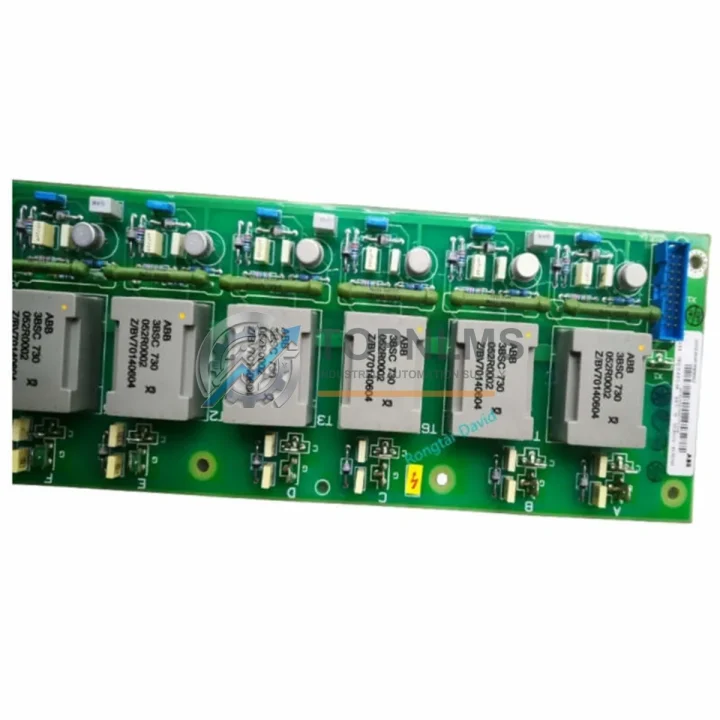
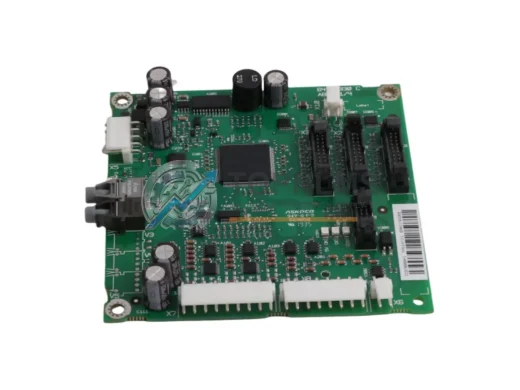
The ABB SDCS-PIN-48-SD is an original pulse transformer board designed for ABB’s SDCS series DC drive systems. As a critical firing circuit interface component, it governs the precise gate-pulse delivery to the thyristor bridge, directly determining the reliability of speed regulation, torque control, and overall drive performance. In industrial environments where DC drives power paper mills, steel rolling lines, extruders, hoists, and large pump stations, the integrity of this board is non-negotiable. A failed or degraded SDCS-PIN-48-SD can cause erratic motor behavior, nuisance trips, or complete drive shutdown — translating directly into costly unplanned downtime.
Sourcing an original ABB SDCS-PIN-48-SD from a verified industrial spare parts supplier ensures that the replacement component meets the exact electrical tolerances and isolation specifications of the factory-installed unit. Counterfeit or non-original pulse transformer boards frequently exhibit substandard insulation, incorrect turns ratios, or inadequate dV/dt ratings, all of which can damage the thyristor stack or the DCS800/DCF803 control board downstream. TOPNLMS supplies only original, tested units with full traceability.
Critical Technical Specs
| Parameter |
Specification |
| Part Number |
SDCS-PIN-48-SD |
| Brand |
ABB |
| Series |
SDCS (DCS800 / DCF803 DC Drive Platform) |
| Function |
Pulse Transformer Board — Firing Circuit Interface |
| Application |
Thyristor gate-pulse isolation and transmission for DC drive converters |
| Compatible Drives |
ABB DCS800, DCF803, and SDCS-series DC drive cabinets |
| Mounting |
PCB plug-in module, SDCS rack-compatible |
| Origin |
Germany (Original ABB manufacture) |
| Weight |
Approx. 300 g |
| Operating Environment |
Industrial control cabinet, 0–55 °C, <95% RH non-condensing |
| Maintenance Recommendation |
Inspect annually; replace proactively at first sign of firing irregularity or thyristor misfiring |
| Warranty |
12 Months — covers manufacturing defects and functional failure under normal operating conditions |
Preventive Maintenance Strategy
When scheduling a planned shutdown or responding to a DC drive fault, the SDCS-PIN-48-SD should never be evaluated in isolation. The pulse transformer board sits at the intersection of the control electronics and the power stage, making it essential to audit the entire firing and power supply chain during the same maintenance window.
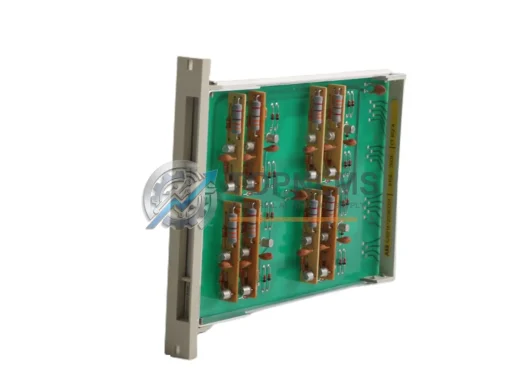
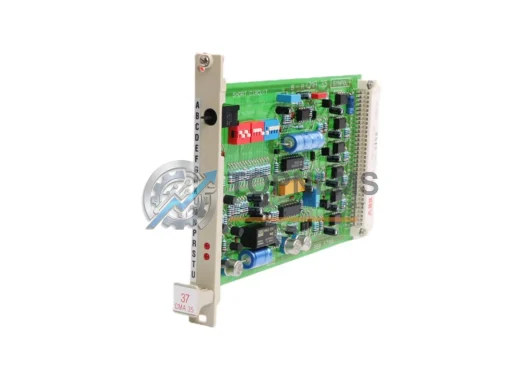
Begin with the SDCS-POW-1 power supply board, which provides the regulated DC rails that feed the SDCS-PIN-48-SD and the rest of the control stack. A power supply with aging capacitors or marginal output voltage will stress the pulse transformer board and accelerate its failure. Simultaneously, inspect the SDCS-CON-F control board — the master controller that generates the firing angle commands; any firmware corruption or communication fault here will manifest as misfiring symptoms that are often misdiagnosed as a pulse transformer failure.
The thyristor modules themselves — typically ABB 5STP or 5STP-series thyristor stacks — should be checked for gate-cathode resistance and leakage current. A shorted or open thyristor will back-stress the SDCS-PIN-48-SD through reflected gate energy. If the drive cabinet uses a SDCS-FEX-2 field excitation board, verify its output stability as well, since field current instability can cause apparent armature control anomalies that lead maintenance teams to incorrectly replace the pulse board.
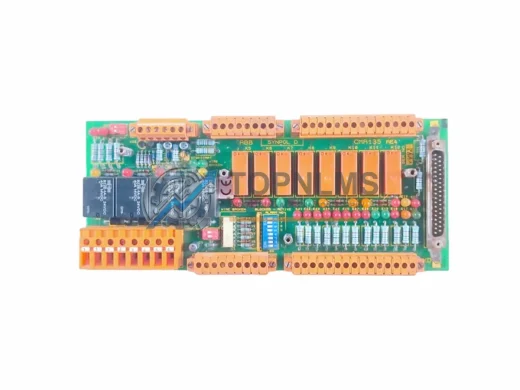
On the signal and communication side, inspect the SDCS-COM-8 or SDCS-COM-81 fieldbus adapter for loose connectors and firmware version compatibility. Communication dropouts can trigger emergency stops that are logged as drive faults, masking the true root cause. The SDCS-DSL-1 digital speed feedback board and associated encoder or tachogenerator wiring should also be verified — speed feedback errors create closed-loop instability that increases thermal cycling stress on all power-stage components including the pulse transformer board.
Do not overlook passive components: DC bus capacitor banks, snubber RC networks across the thyristor stack, and line reactors or AC input chokes all contribute to the electromagnetic environment in which the SDCS-PIN-48-SD operates. Degraded snubbers allow voltage spikes that can punch through the pulse transformer’s isolation. Finally, check the 24 VDC auxiliary power supply feeding the control rack and the fan and cooling system of the drive cabinet — thermal management failures are among the leading causes of premature pulse board degradation in high-cycle industrial applications.
Maintaining a bonded spare of the SDCS-PIN-48-SD alongside a SDCS-POW-1 and a SDCS-CON-F in your on-site spare parts inventory reduces mean time to repair (MTTR) from days to under two hours for most DC drive faults — a critical advantage in continuous-process industries where every hour of downtime carries significant production cost.
Strategic Replacement Solutions
The ABB SDCS-PIN-48-SD is a direct, form-fit-function replacement for earlier pulse transformer interface boards used in legacy ABB Mentor II and DCS400 migration projects where the control architecture has been upgraded to the SDCS/DCS800 platform. Because the SDCS series was designed with backward compatibility in mind, the SDCS-PIN-48-SD can often be installed without modifications to the existing thyristor bridge wiring harness, significantly reducing commissioning time during a drive retrofit.
For plants operating aging DC drive fleets, a proactive replacement strategy — replacing the pulse transformer board at the 8–10 year mark regardless of apparent condition — is far more cost-effective than reactive replacement after a production-stopping failure. The original ABB component ensures that the gate pulse timing, isolation voltage, and signal integrity remain within the drive’s design envelope, preserving the accuracy of the firing angle control and protecting the thyristor investment.
When integrating the SDCS-PIN-48-SD into a refurbished or rebuilt drive cabinet, always perform a full firing angle calibration using the ABB DCS800 commissioning tool (DriveWindow or DriveStudio) after installation. Verify symmetrical firing across all six thyristor gates before returning the drive to service. This step is critical for three-phase fully-controlled bridge configurations where asymmetric firing causes DC ripple, increased motor heating, and torque pulsation.
Support FAQ
Q1: How do I confirm the SDCS-PIN-48-SD is compatible with my specific DCS800 drive variant?
The SDCS-PIN-48-SD is compatible with the full SDCS control platform used across DCS800 and DCF803 drive families. Cross-reference your drive’s hardware manual (document 3ADW000193) or the nameplate on the existing pulse board. If you provide your drive’s full type code, our technical team can confirm compatibility before shipment.
Q2: What does the 12-month warranty cover?
The 12-month warranty covers manufacturing defects and functional failure under normal operating conditions from the date of shipment. Each unit undergoes functional testing prior to dispatch. The warranty does not cover damage resulting from incorrect installation, overvoltage events, or operation outside the specified environmental ratings.
Q3: Can the SDCS-PIN-48-SD be tested on the bench before installation?
Yes. The board can be bench-tested using a DC power supply set to the SDCS control rail voltage and a pulse generator to simulate firing commands. Verify isolation resistance between primary and secondary windings using a 500 V megohmmeter — values below 10 MΩ indicate insulation degradation. TOPNLMS ships each unit with a pre-shipment test record upon request.
Q4: What is the recommended spare parts stocking strategy for SDCS-series drives?
For critical production lines, maintain a minimum of one SDCS-PIN-48-SD, one SDCS-POW-1, and one SDCS-CON-F per drive type in your on-site inventory. For plants with three or more SDCS-platform drives, a pooled spare strategy with two pulse boards and one of each major control module is recommended. This approach balances inventory carrying cost against the risk of extended lead times for original ABB components in the secondary market.