
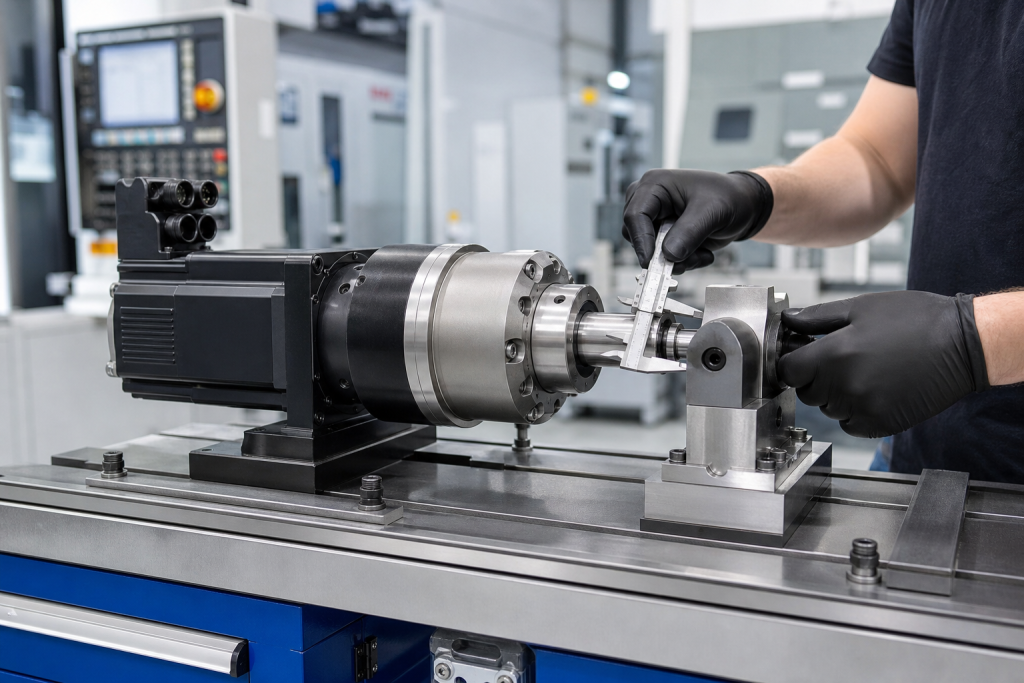
A gearhead can be misidentified even when the motor and gearbox appear to belong to the same machine. Flange, ratio, shaft, backlash, mounting orientation, lubrication, load, and environmental requirements decide whether the replacement will fit and transmit motion correctly. A part number without mechanical evidence leaves too much risk in the RFQ.
TOPNLMS focuses on model checking because motion-control failures often arrive during a narrow production window. The fastest quote is not useful if the gearhead reaches the site with the wrong flange, ratio, shaft, or alignment requirement.
Record the motor-to-gearhead interface
Capture gearhead label, motor model, flange size, bolt pattern, shaft diameter, keyway, ratio, output orientation, mounting position, and the driven load. Photograph the coupling and the machine-side interface before removal where safe.
The live Parker NE23-020 ruggedized planetary gearhead reference is a starting point for a quote, not a substitute for comparing the installed motor flange, output shaft, and machine geometry.
Include safe dimensions, mounting photos, nameplate details, and any signs of backlash, heat, leakage, or impact. If the gearhead is part of a servo axis, include the drive and motor family so the complete motion chain can be reviewed.
Do not substitute on ratio alone
A similar ratio can still produce a different output torque, inertia, backlash, efficiency, mounting direction, or shaft interface. Check the motion profile and the load consequences before considering an equivalent.
For harsh environments, record sealing, temperature, washdown, dust, shock, and lubrication expectations. A laboratory-compatible unit may not be suitable for the installed machine cell.
Ask the quote to separate exact match, possible substitute, repair option, and engineering review. This keeps the mechanical uncertainty visible before purchasing.
Acceptance is an alignment check
After installation, verify mounting, coupling, shaft fit, lubrication, alignment, rotation direction, homing or encoder behavior, noise, temperature, and the machine cycle that matters.
Record whether the unit was only dimension-checked, bench-checked, or accepted on the machine. A gearhead that turns freely by hand is not automatically a production-ready spare.
Save the approved dimensions, photos, ratio, motor interface, and final receiving notes. That record makes the next motion-control RFQ faster and protects the plant from a repeat mismatch.
Build the RFQ around the installed function
A useful spare request begins with the installed function, not only a familiar brand name. State what the device does, where it sits, what it connects to, and what failure would stop or blind the process. Then add the exact label, revision, connector view, power information, accessory scope, condition requirement, destination, and required date. This gives procurement and engineering the same starting point.
Separate an exact replacement from a possible substitute, repair exchange, bench item, and migration candidate. These options may all be commercially useful, but they do not carry the same approval burden. An exact spare may support a short outage window. A substitute may need wiring changes, parameter review, software work, or a production trial before it can be counted as recovery stock.
The product references in this article are live catalog examples, not permission to skip engineering checks. Compare the product page with the installed label and the plant record. If a suffix, connector, voltage, protocol, firmware family, or mechanical interface differs, keep the item conditional until the responsible engineer closes that gap.
Receiving inspection should repeat the evidence used for the RFQ. Photograph the received label, packaging, connectors, terminals, mounting features, and included accessories. Record what was checked and what remains unknown. A clean-looking item is not automatically a field-ready spare, and an item that powers up is not automatically accepted by the control or protection function.
Keep the approved catalog and RFQ reference with the maintenance record, but do not let a catalog title replace the installed evidence. The useful record is the combination of model, function, interface, condition, test requirement, and decision owner. That combination remains valuable even when the next supplier uses a different description for the same hardware family.
Review the spare before the maintenance window, not only after a failure. Confirm that the item is still physically present, that packaging and accessories are intact, that the backup or test procedure is available, and that the responsible engineer is still named. Small changes in wiring, software ownership, or cabinet layout can make an old spare conditional without anyone updating the shelf record.
When a substitute is considered, write down the exact gap it is intended to close and the evidence needed to approve it. This may include a drawing comparison, firmware review, bench test, dimensional check, secondary injection test, communication test, or production trial. A short approval checklist is easier to review than a vague statement that the substitute is equivalent.
The final decision should be visible to stores, procurement, maintenance, and operations. Use plain status labels such as exact replacement, approved substitute, repair exchange, bench-only, or engineering review required. Clear status prevents a useful but conditional item from being pulled as if it were already approved for a live plant function.
FAQ
What should match on a Parker NE23-020 gearhead?
Match flange, ratio, output shaft, keyway, mounting orientation, load, backlash, environment, and motor interface.
Can a similar ratio be used?
Only after torque, inertia, backlash, shaft, mounting, alignment, and machine-cycle requirements are approved.
What photos help the RFQ?
Send the nameplate, motor flange, coupling, output shaft, bolt pattern, machine mount, and safe dimensional evidence.
What proves the gearhead is ready?
Confirm fit, alignment, lubrication, rotation, servo behavior, temperature, noise, and the required machine cycle.
Send TOPNLMS the gearhead label, motor interface, shaft and flange photos, load information, and deadline. We can help turn the mechanical evidence into a precise motion-control RFQ.
© 2026 TOPNLMS. All rights reserved. Official Website: https://topnlms.com Inquiry: [email protected] | WhatsApp/Tel: +86 18359293191