
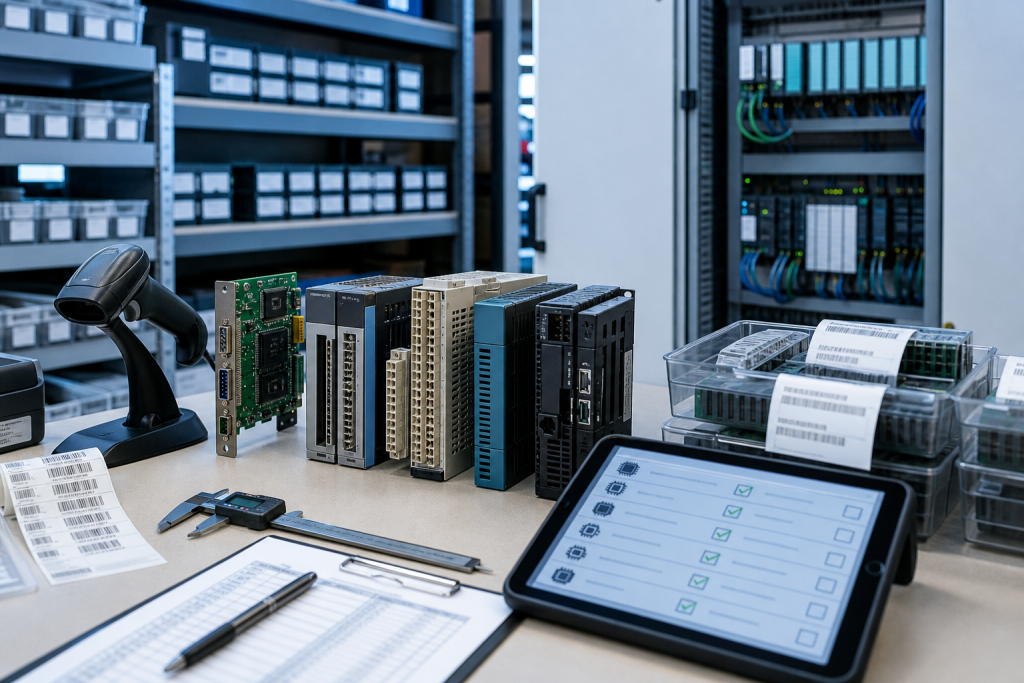
CISA’s June 25, 2026 ICS advisory batch covered several device types, from SCADA software and controller firmware to cameras, engineering tools, and protection equipment. For TOPNLMS buyers, the common lesson is model checking. A plant cannot buy the right spare quickly if the request starts with a vague device name, an old project description, or a cropped photo that hides the label.
Wrong spares usually do not happen because buyers are careless. They happen because industrial hardware families contain small differences that matter: firmware, power input, communication port, option card, terminal style, memory format, mounting, or accessory kit. When an advisory or outage creates urgency, those small differences become expensive. Model checking is the buyer’s first line of protection.
Begin with the full identity
A strong RFQ should include front photo, side label, terminal view, port view, installed cabinet context, quantity, condition requirement, destination, and deadline. If firmware or software version is safely visible, include it. If not, mark it unknown. Do not crop photos so tightly that part numbers, option codes, or connector details disappear.
TOPNLMS keeps these practices in Model Checking because the first answer buyers need is often not price. It is whether the requested item has been identified well enough to quote responsibly. A fast wrong quote is not useful.
Ask what the spare must do
Model checking should include application context. Is the spare for emergency replacement, planned shelf stock, bench testing, or a security review? Is an exact match required, or will engineering consider a substitute? Does the device need accessories, cables, memory, software, or configuration backup? These questions change the acceptable quote.
Substitute offers should be marked clearly. A possible substitute is not an approved spare until engineering checks power, ports, firmware, mounting, communication, configuration, and commissioning steps. This is especially important for mixed PLC, DCS, HMI, relay, and network equipment where similar-looking devices can have different roles.
Accessory scope is another common mistake. Device-only hardware may be enough when existing terminal blocks and cables are reusable. It is not enough when the plant needs a field-ready kit. Ask suppliers to state whether accessories, connectors, brackets, and packaging are included.
Use the advisory as a checklist trigger
When a new advisory appears, buyers can help by preparing evidence before the urgent request arrives. Ask maintenance which installed assets are affected, take safe label photos, confirm whether spares exist, and flag missing accessories. If the plant later decides to update, isolate, replace, or stage a spare, the RFQ evidence is already ready.
For repeat purchases, keep a verified model library. Include accepted matches, rejected offers, accessory requirements, photos, and receiving inspection notes. This library saves time when the same device family appears in another advisory or outage. It also helps new buyers avoid relying on memory.
Receiving inspection completes the model-check loop. Compare delivered labels, ports, terminals, accessory count, and condition against the RFQ. If the item is conditional, label it that way. A substitute should not sit on the shelf pretending to be an exact match.
Buyers should also keep uncertainty visible. If firmware is unknown, write “firmware not confirmed.” If accessories are missing, say “device-only quote.” If engineering has not approved a substitute, mark it “pending review.” Clear uncertainty is much safer than quiet assumption. It tells the next person exactly what still needs attention before the spare can be used.
For companies buying across several plants, model checking can become a shared library. One plant may already have photos, accepted substitute rules, or rejected-offer notes for a module that another plant is now trying to source. A shared record reduces duplicated work and gives procurement a stronger position when comparing supplier responses.
The final habit is simple: photograph the received part before it enters stock. Capture the label, ports, terminals, accessory count, and package condition. Those photos close the loop between RFQ and delivery. They also give the next RFQ a verified reference instead of forcing the buyer to reopen the same identification problem months later.
TOPNLMS also recommends separating urgent replacement from planned sourcing. Urgent replacement needs fast dispatch, clear accessory scope, and low ambiguity. Planned sourcing can allow more time for substitute review, consolidated shipping, and price comparison. When those two needs are mixed together, suppliers may answer with options that are technically real but operationally hard to use.
A good buyer note can be short: exact match required, substitute allowed after approval, device-only acceptable, or complete kit required. Those four phrases remove much of the confusion that usually slows an industrial spare RFQ response under pressure.
FAQ
What is model checking in industrial spare sourcing?
It is the process of verifying the exact device identity, options, firmware, ports, accessories, and acceptable substitutes before ordering.
Why do similar-looking modules cause problems?
Small differences in firmware, power, communication, terminal style, memory, or mounting can prevent installation or require engineering rework.
Should buyers send configuration files with an RFQ?
No. Send safe identification evidence and backup status only. Keep credentials and confidential configuration inside approved plant processes.
How can I speed up a TOPNLMS quote?
Send full photos, exact model labels, quantity, condition, destination, deadline, and accessory needs through the RFQ Tips workflow.
Send TOPNLMS your label photos, model notes, accessory requirements, condition preference, and deadline. We can help verify the spare request before price comparison starts.
© 2026 TOPNLMS. All rights reserved. Official Website: https://topnlms.com Inquiry: [email protected] | WhatsApp/Tel: +86 18359293191