
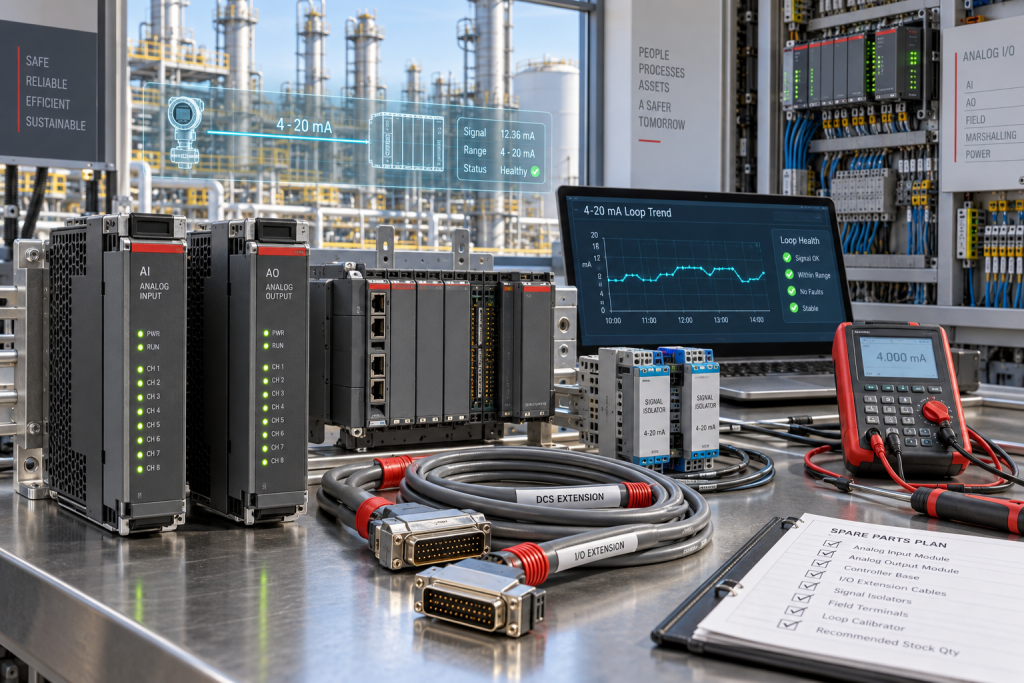
Analog loop recovery on older Honeywell TDC 3000-compatible systems depends on more than a module number. The RFQ should show the loop role, signal range, terminal path, extension cable, diagnostics, process consequence, and acceptance test.
TOPNLMS covered ABB robot, Emerson Ovation, ProSoft, and Woodward/Basler in the latest posts. A Honeywell analog I/O topic adds a process-control spare angle without repeating yesterday’s robot story.
Start With The Loop And Cable Path
Record loop tag, signal range, module role, extension cable, terminal strip, transmitter or valve connection, diagnostics, alarm history, and the production consequence of losing the loop.
The first product reference checked before drafting was Honeywell 2MLF-DV8A Original Industrial Spare TDC 3000 Compatible. It belongs in the discussion because the article is about the same installed risk, not because a link is needed at the end of the page.
The second published reference was Honeywell 2MLF-DV4A Ruggedized Analog Output Module. Using two real, public product pages gives maintenance and procurement a practical vocabulary for labels, suffixes, connectors, and acceptance evidence.
Analog Recovery Is Sensitive To Small Details
A module may look correct while cable length, terminal condition, signal isolator, grounding, or field device status still prevents stable readings.
Ask suppliers for actual photos, tested status, connector and cable condition, accessory scope, and notes about compatibility with the installed TDC 3000-compatible arrangement.
A spare request should be written like a compact engineering handover. It needs the installed part identity, cabinet location, accessories, field wiring, software or parameter dependency, observed symptom, and the test that decides whether the part is acceptable. Without that evidence, the buyer is forced to compare catalog names instead of recovery risk.
Acceptance Should Prove The Signal
After replacement, verify module diagnostics, 4-20 mA or voltage signal, HMI value, alarm behavior, trend stability, loop response, and operations approval.
If the loop remains unreliable, review field device power, terminal wiring, extension cable seating, shielding, grounding, signal isolators, and configuration before rejecting the spare.
The plant should also record what remains unknown. Firmware, backup files, licenses, calibration records, communication schedules, safety validation, and loop checks are site responsibilities. A supplier can confirm hardware identity and condition, but system readiness is proven only when the installed function passes the plant test.
Procurement Notes For Maintenance Teams
Ask for actual photos before approving shipment. Front labels, side labels, connector faces, terminal screws, rack position, LED state, daughter boards, batteries, cable tags, and accessory kits can reveal compatibility details that a one-line part number hides.
Separate emergency recovery from planned inventory. An emergency purchase may accept narrower evidence and faster freight, while a shelf spare should have cleaner documentation because it may be used by a different shift months later.
Condition terms should be specific. Factory sealed, new surplus, refurbished, repaired exchange, tested used, and untested used carry different risk. The RFQ should state which conditions are acceptable and what test evidence must accompany the offer.
Do not treat similar modules as automatic substitutes. Older PLC, DCS, SIS, HMI, drive, motion, robot, and condition-monitoring families often change by suffix, firmware, termination, memory, channel isolation, communication option, or cabinet depth.
Receiving inspection should repeat the sourcing evidence check. Compare the delivered item to the approved photos, confirm accessory scope, inspect connectors and terminals, record serial or revision details, and decide whether the part goes to stores, bench test, or immediate installation.
If a substitute is proposed, define the engineering review before purchasing releases the order. The reviewer should check fit, function, firmware or parameter impact, communication behavior, field wiring, safety consequence, and rollback plan.
For multisite groups, use a common RFQ format but allow local acceptance rules. A utility pump, turbine train, safety loop, valve skid, motion axis, robot cell, and operator panel do not carry the same consequence, even when the part numbers look routine.
A useful blog article for engineers should help the reader do the next practical step. That is why today’s topic is tied to real published product pages, current industry monitoring, and the evidence needed to move from research to a quote.
The best inquiry is short but complete: brand, full model, quantity, acceptable condition, installed role, photos, failure symptom, deadline, destination, and the acceptance test. That information reduces rework and makes supplier answers easier to compare.
Keep the final record with the spare. Product link, supplier evidence, photos, test notes, and acceptance status become valuable when the same platform fails again or when management asks why modernization should be funded.
The search angle also matters. Engineers may search by model number, but purchasing teams often search by family name, system name, or failure mode. A good article and a good RFQ should support both paths without stuffing keywords or forcing irrelevant products into the conversation.
When official support is limited, the quality of the installed evidence becomes even more important. Legacy hardware can often be kept reliable, but only when the site can prove what is installed, what is interchangeable, and what test will protect production after replacement.
FAQ
What must match on a Honeywell TDC 3000 analog spare?
Match module or cable identity, loop role, signal range, termination, connector condition, diagnostics, and loop-test method.
Why include extension cable evidence?
Cable condition and connector fit can decide whether an analog module produces a stable field signal.
What should procurement send?
Send labels, cable photos, terminal photos, loop tag, signal range, condition requirement, quantity, and deadline.
What proves recovery?
Healthy diagnostics, stable signal reading, correct HMI trend, cleared alarms, and approved loop-response testing.
Send TOPNLMS the Honeywell TDC labels, analog loop tag, extension cable photos, terminal evidence, signal range, and deadline. We can help prepare a DCS spare RFQ.
© 2026 TOPNLMS. All rights reserved. Official Website: https://topnlms.com Inquiry: [email protected] | WhatsApp/Tel: +86 18359293191